

Views: 0 Author: Site Editor Publish Time: 2026-05-01 Origin: Site


Precision mold making traditionally relies on highly skilled labor alongside expensive multi-axis milling centers or EDM equipment. Defaulting to 5-axis mills for all components artificially inflates your tooling expenses. Manufacturers often overlook the specific efficiency of turning operations for cylindrical mold components. This oversight leads to unnecessary machine-hour expenses and severely prolonged lead times.
Integrating a high-precision CNC Lathe for axially symmetrical mold parts drastically lowers hourly machining rates. It also significantly reduces setup times for core pins, ejector sleeves, and sprue bushings. By evaluating your shop floor routing strategies, you can uncover massive hidden savings without sacrificing component quality.
This article provides a technical and financial framework for manufacturing decision-makers. You will learn how reallocating rotational mold geometry impacts production costs, material yield, and downstream injection cycle efficiency.
Lower Hourly Machine Rates: CNC lathes typically operate at significantly lower hourly costs compared to 4- or 5-axis milling machines, driving immediate cost savings for symmetrical parts.
Accelerated Lead Times: Transitioning from traditional grinding or EDM to advanced CNC turning can reduce component fabrication time from weeks to days, achieving tolerances as tight as ±0.005 mm.
Downstream Efficiency: Superior surface finishes generated by lathe turning eliminate secondary polishing needs and improve injection mold release, optimizing the final cycle time.
Strategic DFM: Up to 85% of a mold component’s cost is locked in during design; optimizing geometry specifically for lathe operations is the highest-leverage cost-reduction strategy.
Allocating machine time correctly remains one of the most critical routing decisions in a mold shop. Many facilities blindly send every mold component to multi-axis machining centers. This approach ignores the inherent financial inefficiency of cutting axially symmetrical parts on high-end mills.
A standard 3-axis or 5-axis mill carries hourly rates often ranging from $80 to over $200. These machines demand intensive programming, complex tool magazines, and highly skilled operators. In contrast, standard CNC turning centers operate at a significantly lower baseline cost. Hourly rates for lathes frequently sit between $50 and $80. Shifting rotational parts away from premium milling centers instantly slashes your baseline manufacturing spend.
To maximize your return on investment (ROI), you must identify which specific components belong on a lathe. Ideal target mold applications include:
Core pins
Ejector pins and sleeves
Guide pillars and bushings
Round cavity inserts
Sprue bushings
Modern equipment introduces another major financial advantage: the "mill-turn" capability. Advanced CNC lathes feature live tooling, allowing them to consolidate operations. Previously, a machinist would turn a core pin on a lathe, then move it to a mill to cut an anti-rotation flat or a complex cooling channel. Live tooling handles these off-center features in a single setup. Consolidating these steps drastically reduces fixture costs, eliminates secondary queuing times, and prevents human error during part transfer.
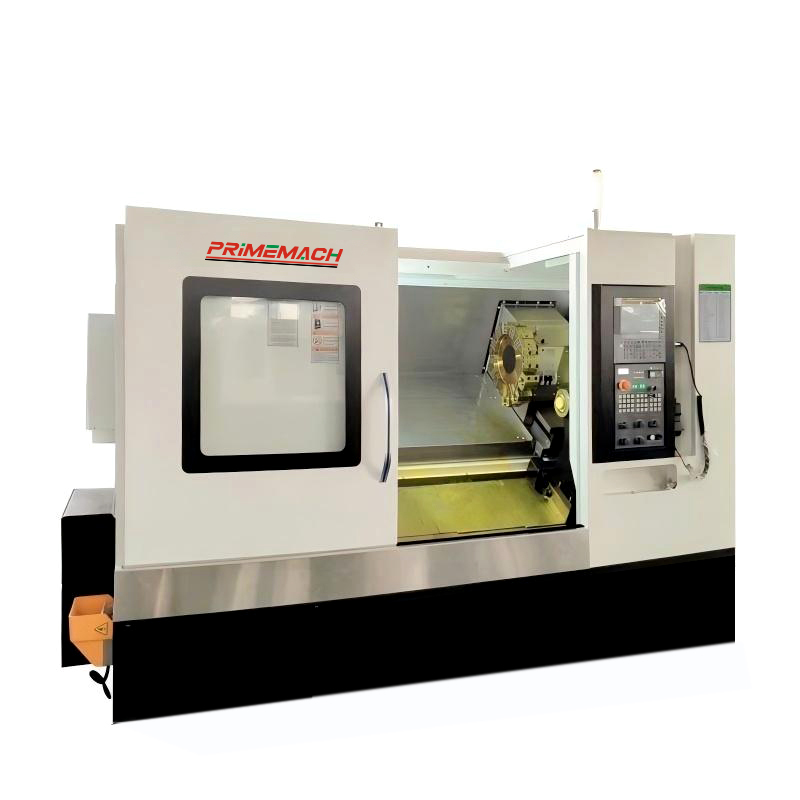
The physical mechanics of turning provide distinct cost advantages over milling. Cycle time compression represents the most immediate benefit. When evaluating material removal rates (MRR) for cylindrical geometry, turning vastly outperforms milling. Lathes remove bulk material through continuous cutting. The tool stays engaged with the spinning workpiece constantly. Milling relies on interrupted cutting, where individual flutes strike the material and exit repeatedly. Continuous cutting inherently removes material faster and more smoothly.
Setup minimization also drives down direct labor costs. Chucking a cylindrical blank in a lathe takes seconds using a standard 3-jaw chuck or collet system. Securing that same round stock to a mill bed often requires custom soft jaws, V-blocks, or complex clamping arrays. Reducing these setups minimizes expensive labor hours. Fewer setups also eliminate tolerance stacking errors, ensuring the part remains concentric from end to end.
Tooling longevity presents another major cost variable, especially when machining hard metals. Mold makers frequently work with tough materials like H13 tool steel, P20 pre-hardened steel, or Beryllium Copper.
Lathe inserts maintain continuous engagement during the cut. This stability distributes heat directly into the chip rather than the tool edge. You gain highly predictable tool wear and substantially lower consumable costs. Conversely, end mills in deep-cavity applications suffer from variable chiploads, thermal shock, and chatter, leading to frequent and expensive tool breakages.
Production Metric | Multi-Axis Milling | CNC Turning (Lathes) |
|---|---|---|
Cutting Action | Interrupted (high thermal shock) | Continuous (stable tool wear) |
Setup Complexity | High (often requires custom fixtures) | Low (standard collets/chucks) |
Typical Hourly Rate | $80 - $200+ | $50 - $80 |
Concentricity Control | Prone to stacking errors over multiple setups | Excellent natural concentricity in one setup |
The financial benefits of turning extend far beyond the machine shop floor. Precision lathe work directly influences the profitability of the final injection molding process. A smoother surface finish achieved directly off the lathe reduces mechanical friction. Turning can routinely achieve exceptional Ra values without requiring secondary cylindrical grinding.
This pristine finish impacts the ejection mechanics of the plastic part. Smoother core pins ensure seamless part ejection, which dramatically reduces defect rates, plastic sticking, and overall scrap. Every saved part directly boosts your yield.
Furthermore, precision-turned core pins allow for highly accurate internal cooling channels. Cooling phases frequently account for over 50% of an injection molding cycle. If a cooling channel lacks concentricity, the pin wall thickness varies. Uneven walls cause hot spots, forcing operators to extend cooling times. Tighter concentricity achieved on a lathe maximizes thermal transfer. This optimization directly shortens the cycle time, increasing your part yield per hour.
Finally, high repeatability guarantees component interchangeability. Advanced turning centers control variances to sub-micron levels. When an ejector pin wears out during a high-volume run, technicians can swap a replacement pin in minutes without manual custom fitting. This plug-and-play interchangeability prevents expensive production downtime and keeps injection molding machines running.
Adopting strategic Design for Manufacturability (DFM) principles for CNC Lathes in Precision Mold Making fundamentally shifts how engineers approach part geometry. Up to 85% of a component’s cost becomes locked in during the CAD phase. You can unlock massive savings by designing parts specifically for turning.
Follow these essential DFM rules to optimize your mold components:
Blank Size Optimization: Always account for raw blank size properly. Select a raw bar stock diameter as close to the maximum part diameter as possible. This simple step minimizes wasted material, drastically reduces roughing time, and limits machine wear.
Tolerance Discipline: Over-tolerancing destroys profit margins. Only specify extreme tolerances (e.g., ±0.005 mm) on critical mating surfaces or shut-offs. Defaulting to standard tolerances (±0.125 mm) on non-functional areas slashes unnecessary machining time and inspection bottlenecks.
Aspect Ratios and Thin Walls: Engineers must address the risks of tool deflection. Slender core pins vibrate easily during heavy cuts. Design guidelines must dictate maximum length-to-diameter ratios to avoid chatter. If long aspect ratios remain necessary, clearly require the use of tailstocks or steady rests in your manufacturing notes.
Internal Geometry: Avoid specifying sharp internal corners at all costs. Sharp corners require fragile, specialized tools or slow secondary EDM processes. Instead, design every internal step with a radius. Ensure this radius at least matches standard tool nose radiuses, allowing standard inserts to flow cleanly through the geometry.
Not all lathes handle mold-making tolerances effectively. When auditing your shop floor or evaluating a new manufacturing partner, you must look for specific equipment capabilities tailored to precision tooling.
First, evaluate the spindle RPM and precision constraints. Miniaturized mold components, like micro-sprue bushings or tiny ejector pins, require exceptionally high spindle speeds. You must maintain proper surface feet per minute (SFM) on small diameters to achieve a clean cut. Evaluate machines capable of reaching 10,000+ RPM while maintaining absolute thermal stability. Spindle chillers become mandatory here to prevent thermal expansion during long runs.
Next, assess automation readiness. Mold makers frequently produce high volumes of standardized pins and bushings. Look for integration with bar feeders or robotic part catchers. Embracing "lights-out" manufacturing transforms fixed labor costs into highly scalable profit margins. Machines running overnight unassisted deliver the highest possible ROI.
Finally, inspect the machine's rigidity for hard turning. Eliminating post-heat-treat grinding represents a massive cost saving. However, cutting pre-hardened tool steels (45-60 HRC) demands immense structural stability. Shortlist heavy-duty, box-way lathes over linear-guide lathes for these tasks. Box-way guideways dampen vibrations significantly better, ensuring tight tolerances and flawless finishes even under intense cutting pressures.
Deploying a CNC lathe for appropriate mold components is not just a routing decision; it is a vital, strategic cost-containment measure. Turning shifts demanding work away from expensive milling bottlenecks, eliminates secondary grinding processes, and shortens lead times drastically. By embracing continuous cutting over interrupted milling, shops lower their tooling costs and improve their overall throughput.
We advise procurement and engineering teams to audit their current mold designs immediately. Identify high-volume symmetrical components within your assemblies. Request detailed time-studies from your manufacturing partners comparing multi-axis milling versus turning costs.
Take action today by submitting a CAD model for a comprehensive DFM review. Discover the exact cost savings your facility can achieve through dedicated precision turning operations.
A: For external cylindrical features and certain hard-turning applications, yes. Hard turning can often replace cylindrical grinding and wire EDM, dramatically reducing lead times. However, EDM remains absolutely necessary for machining deep, sharp-cornered cavities and intricate blind features that rotating tools cannot physically access.
A: For prototypes or low-volume runs (under 10,000 cycles), Aluminum (like 6061 or 7075) is highly machinable and cost-effective. For high-volume production, pre-hardened steels like P20 offer a good balance of machinability and durability, while H13 is harder and requires more rigid machine setups.
A: Standard 2-axis CNC lathes typically have lower hourly operating rates ($50–$80/hr) compared to 3-axis mills ($60–$100/hr) and 5-axis mills ($120–$200+/hr). Designing axially symmetrical parts specifically for the lathe is a proven cost-reduction strategy.
A: High-end precision turning centers can consistently hold tolerances of ±0.005 mm (or roughly 0.0002 inches) under controlled thermal conditions. This precision meets the stringent requirements for injection mold shut-offs and sliding fits without requiring secondary grinding.


