

Views: 0 Author: Site Editor Publish Time: 2026-05-12 Origin: Site


In the oil and gas sector, a single component failure often translates to catastrophic downtime, environmental hazards, and massive financial loss. Subsea valves, drill collars, and packers operate continuously under extreme pressure, corrosive fluids, and high thermal loads. Manufacturing these vital parts demands extreme dimensional accuracy and perfect surface finishes. Standard manufacturing equipment simply cannot reliably achieve these rigorous specifications on a consistent basis. This forces manufacturers to seek out highly specialized capabilities to maintain structural integrity.
This guide breaks down how you can evaluate and select the optimal machining equipment for these harsh environments. You will learn how to handle aerospace-grade tolerances of up to 0.0001 inches while cutting exotic alloys specific to the energy sector. Ultimately, we will show you how to guarantee strict compliance with critical API standards and protect your production workflows from costly errors.
Machine-to-Part Mapping: Selecting the right lathe architecture (e.g., long-bed vs. VTL) is dictated by part geometry—such as using heavy-duty long-beds for 120-inch drill collars or VTLs for massive blowout preventer (BOP) flanges.
Material Realities: High-precision lathe machines must possess the rigidity and thermal stability to handle difficult-to-machine alloys like Inconel 718 and 13CR-L80 without tool deflection or work hardening.
Tolerance & Compliance: Meeting API-5B and API-7-2 thread standards requires advanced features like thermal compensation, multi-axis integration, and independent 4-jaw chuck setups.
Energy extraction presents unforgiving operational realities. When manufacturing large shafts or subsea components, the cost of inaccuracy is staggering. A tailstock misalignment of just 0.001 inches easily causes taper defects in long shafts. These minor deviations severely compromise high-pressure seals. When a seal fails thousands of feet underwater, the resulting blowout can cost millions to remediate. Precision is not optional; it is the absolute foundation of energy safety.
Achieving exact surface finishes is equally critical. Pipeline inspection gauges (PIGs) require a surface roughness of Ra 0.4 μm. Any rougher, and the equipment might score the pipeline interiors. Achieving these theoretical roughness limits relies on strict physics. It requires managing the exact relationship between feed rate, tool nose radius, and machine vibration. You calculate theoretical roughness using the formula Ra = f²/32r. Standard lathes vibrate too much to hit these numbers consistently. Extreme rigidity is necessary to damp out chatter and leave a flawless finish.
We often see debates comparing CNC machining to additive manufacturing for critical components. For the most demanding oilfield parts, solid billet machining remains the undisputed standard. Additive manufacturing layers can introduce microscopic voids and anisotropic weaknesses. Directional drilling tools face immense, twisting torque underground. They require the isotropic strength only found in forged solid billets. You must machine these billets carefully to preserve their structural integrity.
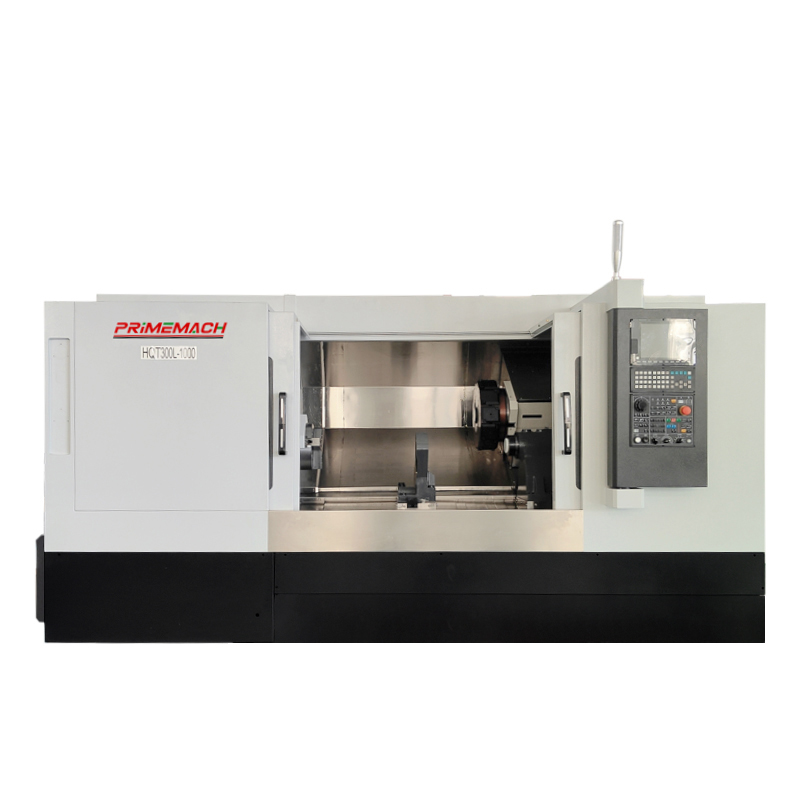
You cannot just look at a machine's spec sheet in isolation. You must map the machine architecture directly to the exact oil and gas parts it produces best. Different geometries demand entirely different kinematic approaches. Below is a detailed breakdown of how different architectures serve the energy sector.
Machine Architecture | Target Oil & Gas Parts | Key Evaluation Metrics & Capabilities |
|---|---|---|
Heavy-Duty Long-Bed Lathes | Drill collars, pup joints, riser systems, long-shaft control mechanisms. | Must accommodate 120-inch lengths. Requires ultra-rigid steady rests and specialized deep-hole boring systems. |
Vertical Turning Lathes (VTLs) | Large-diameter flanges, pump housings, heavy valve bodies, blowout preventers (BOPs). | Gravity assists with seating massive, asymmetrical workpieces. Drastically reduces clamping distortion. |
Slant-Bed CNC Turning Centers | Liner hangers, packers, complex threaded connectors, tight-tolerance sealing components. | Provides superior chip evacuation and cutting force distribution compared to flat-bed designs. Essential for tough alloys. |
A heavy-duty long-bed lathe is non-negotiable for producing 120-inch drill collars. You need specialized deep-hole boring tools integrated into the machine. Without ultra-rigid steady rests, the workpiece will sag under its own weight. Conversely, you should process a massive blowout preventer flange on a Vertical Turning Lathe (VTL). VTLs let gravity hold the heavy, asymmetrical forging down. This natural seating minimizes clamping forces, preventing part distortion during heavy cuts.
For mid-sized, complex items like liner hangers, a slant-bed turning center wins. The angled bed allows heavy metal chips to fall away naturally. It also directs cutting forces straight down into the heaviest part of the machine casting. This setup reduces vibrations when carving out tough energy-sector alloys.
Evaluating machining equipment requires grounding your assessment in engineering realities. Modern oilfield environments are highly corrosive and extremely hot. The alloys built to survive these conditions actively resist being cut. High-Precision Lathe Machines for Critical Oil and Gas operations must possess the raw power and extreme rigidity needed to counteract these material challenges.
Inconel 718 is notorious across the manufacturing industry. It has a machinability rating of roughly 12% compared to standard carbon steels. It is highly susceptible to work hardening. If your tool rubs against the material instead of slicing it, the surface hardens instantly. The next pass will shatter the insert. To prevent this, you need a high-torque spindle and extreme tool-post rigidity. These features maintain a constant, aggressive chip load without stalling or deflecting.
Sour gas wells contain lethal amounts of hydrogen sulfide. Parts going into these wells must comply with NACE MR0175 standards. This typically means machining 13CR-L80 or duplex stainless steels like 2205. These materials generate immense heat at the cutting edge. Your machine needs high-pressure, through-tool coolant delivery. Flooding the cutting zone flushes chips away and prevents localized thermal expansion.
Internal drive components require tight-sealing tolerances to function. You will typically machine these from materials like M50 VIM-VAR or 17-4 PH stainless steel. Achieving tight tolerances on these hard metals requires high spindle speeds. However, high speeds introduce chatter. You must counteract this with vibration-dampening machine beds. High-grade cast iron or epoxy mineral cast bases absorb resonant frequencies far better than welded steel frames.
Procuring capital equipment involves high stakes. We recommend using a strict, vendor-agnostic checklist when evaluating High-Precision Lathe Machines for critical oil and gas applications. Look past basic spindle speeds and focus on systems designed to mitigate process variations.
Spindle Performance and Thermal Compensation: Long machining cycles generate tremendous heat. This heat transfers into the machine casting, causing it to expand. This thermal drift ruins tight tolerances. Look for built-in thermal compensation systems. These use sensors to detect temperature changes and automatically adjust the CNC coordinates to counteract drift.
Workholding Accuracy: Standard 3-jaw self-centering chucks are insufficient for critical seals. They often max out at 0.010 inches of runout. Evaluate machines that support high-precision independent 4-jaw chucks. These allow operators to dial in total indicator runout (TIR) to 0.0001 inches. Specialized hydraulic steady rests are also crucial for supporting long shafts.
Multi-Axis and Live Tooling Integration (Y/C-Axis): Reducing setups is the best way to prevent tolerance stacking. Every time you unclamp a part to move it to a mill, you lose accuracy. 5-axis integration allows you to perform milling, drilling, and turning in a single operation. This approach is absolutely critical for manufacturing complex valve blocks.
Control Systems & Collision Avoidance: High-value forgings made of Titanium or Hastelloy cost thousands of dollars. Scrapping one due to a programming error is exceptionally costly. Real-time CAD/CAM integration is a mandatory risk-mitigation feature. Look for a CNC controller with digital twin technology. It simulates the exact tool path to prevent collisions before the spindle ever turns.
You cannot separate the machining process from the final quality inspection. In the energy sector, compliance is a legal and operational necessity. Integrating quality control directly into your machining strategy reduces scrap and protects your reputation.
Producing rotary shouldered connections, casing, and tubing threads demands strict adherence to API-5B and API-7-2 standards. You cannot cut API threads manually. The machine's control system must handle complex threading cycles flawlessly. It needs perfect synchronization between spindle rotation and Z-axis feed. Any lag during the threading pass alters the thread pitch, leading to immediate rejection during gauge inspection.
Never take a machine's stated accuracy at face value. We recommend buyers request test cuts on their specified alloys before signing a purchase order. Do not accept test cuts on aluminum if you plan to cut Inconel. Ask the vendor for comprehensive CMM (Coordinate Measuring Machine) reports proving the machine's capability. This verification step is equally important if you are outsourcing production to a third-party machine shop.
The latest breakthrough in production risk mitigation is predictive maintenance powered by the Internet of Things (IoT). Modern high-precision lathes feature spindle vibration monitoring and AI-driven tool-wear prediction.
Sensors detect microscopic changes in acoustic emissions.
The software predicts exactly when a carbide insert will fail.
The machine alerts the operator to swap the tool automatically.
Replacing an insert just before it chips prevents catastrophic damage. It saves the $10,000 raw Inconel forging and prevents massive spindle rebuild costs.
Securing the right high-precision lathe machines for critical oil and gas manufacturing is a delicate balancing act. You must perfectly match your part envelope, material hardness, and required tolerance limits to the machine's architecture. Standard equipment simply cannot survive the extreme rigidity and thermal demands of machining Inconel or 13CR-L80.
Technical buyers and production managers should take immediate action. Audit your current scrap rates on exotic alloys. If you see high tool failure or inconsistent thread quality, your equipment is likely holding you back. Evaluate whether upgrading to a slant-bed or thermally-compensated platform makes sense for your shop. Implementing these advanced systems yields immediate returns through improved tool life, faster cycle times, and absolute compliance consistency.
A: API thread cutting requires precise synchronization between spindle rotation and Z-axis feed. If they fall out of sync, the thread pitch alters. A suitable CNC lathe possesses robust servo motors, instantaneous controller response times, and extreme structural rigidity to prevent chatter during heavy threading cycles.
A: Slant-bed lathes excel at chip evacuation. When cutting tough materials, chips easily fall away rather than building up and scoring the part. Additionally, the angled bed directs heavy cutting forces down into the machine base, increasing rigidity and minimizing vibration.
A: Yes, but they require specific configurations. Machining alloys like 13CR-L80 requires high-pressure, through-tool coolant systems to manage extreme heat. The machine also needs exceptional spindle torque to maintain a constant chip load, preventing the material from work hardening mid-cut.
A: Weight directly translates to vibration damping. Oil and gas parts are massive and made from tough alloys. Roughing these forgings generates immense chatter. Heavier cast iron or mineral cast beds absorb these resonant frequencies, ensuring a smooth surface finish and extending tool life.


