

Views: 0 Author: Site Editor Publish Time: 2026-08-10 Origin: Site


The medical device industry rapidly drives toward extreme miniaturization for implantable and surgical equipment. We constantly see this critical shift in components like neural probe connectors, delicate bone pins, and tiny pacemaker contacts. These vital parts must now be reliably manufactured at incredibly demanding microscopic scales.
Scaling the production of these sub-millimeter components presents immense mechanical hurdles for engineering teams. Manufacturers struggle daily to maintain pristine dimensional stability, flawless surface finish, and uncompromising biocompatibility. Standard production methods frequently fail at these dimensions, causing unacceptable scrap rates and posing risks to patient safety.
This comprehensive guide gives engineering and procurement teams a highly practical evaluation framework. You will discover exactly how to assess advanced turning technologies for demanding micro-scale applications. We will also help you confidently select manufacturing partners who can consistently hold strict micro-tolerances during high-volume production.
Machinery Alignment: Matching part complexity to the right equipment—such as choosing a CNC Gang Tool Lathe for high-volume, simple pins versus a Servo Turret CNC Lathe for multi-feature connectors—dictates baseline unit economics.
Material Realities: Machining medical-grade Titanium and PEEK at micro-scales requires specific thermal management and tool-wear strategies to prevent part deformation.
Compliance Integration: True medical micromachining relies on rigorous process validation (IQ/OQ/PQ) and 100% optical inspection, not just standard ISO 13485 certification.
Vendor Vetting: A capable partner must demonstrate verifiable strategies for burr-removal, tool life management, and lot-level traceability.
Precision is not merely a goal in medical device manufacturing; it serves as a strict baseline for patient survival. When evaluating micro-components, engineers must carefully define the stakes associated with part failure. If an electrical connector in an implantable defibrillator fails, the device cannot deliver life-saving impulses. If a surgical guide pin suffers from slight misalignment, a surgeon might drill a bone trajectory incorrectly, leading to catastrophic clinical outcomes.
Moving from standard industrial machining to true medical micromachining introduces entirely new physical realities. We define micromachining as the production of parts under 0.125 inches (3.175mm) in diameter. At this scale, the physics of cutting metal fundamentally changes. The cutting tool radius often approaches the depth of the cut itself. This phenomenon causes the tool to rub against the material rather than shearing it cleanly. Engineers call this the "ploughing effect," and it frequently pushes tiny parts away from the cutting edge, destroying dimensional accuracy.
Different medical components require vastly different machining priorities to guarantee clinical success. We must map specific part features directly to their intended patient outcomes:
Medical Pins: These require absolute straightness and entirely burr-free points. Even a microscopic burr on a bone pin can tear surrounding soft tissue, causing unnecessary trauma and prolonging patient recovery times.
Connectors: These demand flawless concentricity and superior surface finishes. Smooth, perfectly aligned surfaces ensure uninterrupted electrical signal transmission, especially in fluid-heavy physiological environments.
Traditional turning centers regularly fail at these miniature dimensions. A standard lathe generates subtle spindle vibrations. While a 0.0005-inch vibration goes unnoticed on an automotive shaft, it completely ruins a medical probe connector. Furthermore, thermal expansion poses a massive threat. As standard machines run, their cast-iron frames heat up and expand. A minor temperature shift can push the cutting tool out of tolerance, resulting in skyrocketing scrap rates. To conquer these challenges, manufacturers must deploy highly specialized turning equipment.
Selecting the optimal equipment dictates project success. Engineering teams must evaluate machine types based strictly on part geometry, material rigidity, and production volume. You cannot force a highly complex micro-part onto a basic macro-lathe and expect repeatable results.
When high-volume production of relatively straightforward parts is required, we often look toward a CNC Gang Tool Lathe. This configuration mounts cutting tools in a linear row on a single cross-slide, eliminating the need for a rotating turret.
This setup works exceptionally well for medical pins, basic contacts, and simple shafts. The advantages are substantial. Because the machine does not unclamp, rotate, and reclamp a heavy turret, chip-to-chip times drop to fractions of a second. This delivers exceptional speed. More importantly, the lack of moving turret indexers significantly boosts mechanical rigidity and positional repeatability. When turning micro-diameters, this rigidity prevents tool deflection, ensuring every bone pin matches the exact specifications of the first.
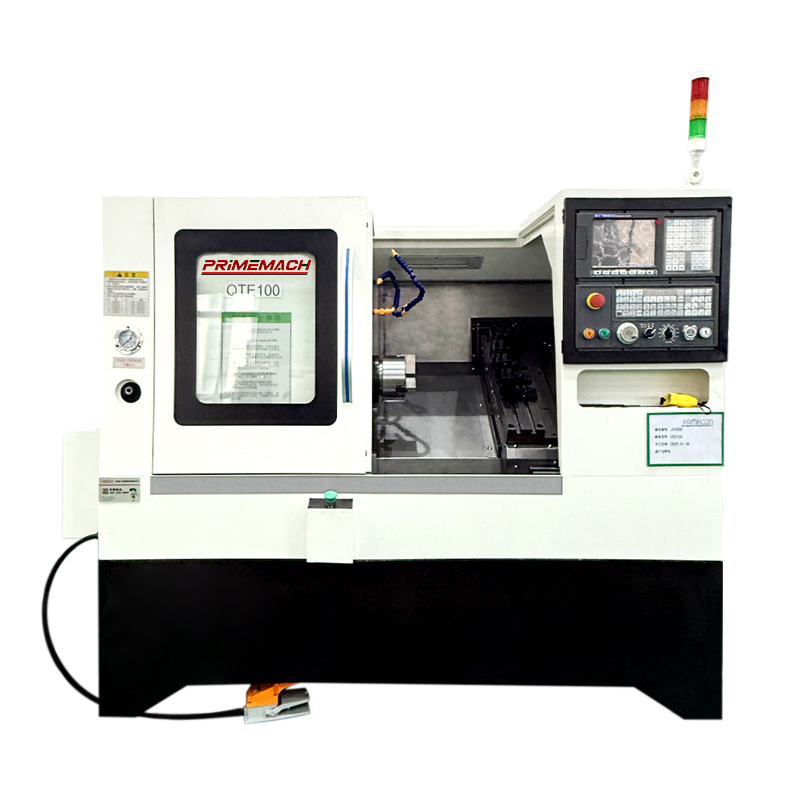
Micro-connectors often feature intersecting holes, milled flats, and tiny threads. For these multi-feature parts, a Servo Turret CNC Lathe becomes necessary. This machine utilizes a rotating turret driven by highly accurate servo motors.
This configuration easily manages complex medical connectors requiring multiple distinct operations in a single setup. By integrating live tooling (power-driven milling cutters and drills mounted in the turret), the machine can create off-center features without ever ejecting the part. High-speed servo motors provide exact, rapid positioning for intricate geometries, reducing overall cycle times while keeping concentricity tightly controlled.
We must briefly contextualize the Swiss-style lathe. When a component features a length-to-diameter ratio exceeding 3:1, the material will almost certainly bend away from the cutting tool. Swiss machines solve this by utilizing a guide bush. The guide bush firmly supports the material just millimeters away from the cutting action, allowing manufacturers to turn long, slender medical implants without deflection.
Medical Turning Equipment Comparison Chart
Machine Configuration | Best Medical Application | Primary Advantage | Setup Complexity |
|---|---|---|---|
Gang Tool Lathe | Bone pins, simple contacts | High rigidity, extremely fast cycle times | Low to Medium |
Servo Turret Lathe | Connectors, multi-feature housings | Live tooling integration, high-capacity tool storage | Medium to High |
Swiss-Type Lathe | Long guide wires, slender implants (L/D > 3:1) | Prevents deflection on long parts via guide bush | High |
Medical device designers face a constant tug-of-war between regulatory demands and manufacturing realities. A material might offer perfect biocompatibility inside the human body but behave terribly inside a machine tool. Understanding these material characteristics is essential before initiating any micro-turning project.
Titanium dominates the orthopedic and implantable sector due to its high strength and inert nature. However, it presents severe risks at micro-scales. Titanium possesses notoriously low thermal conductivity. Instead of the heat escaping through the metal chips, the heat focuses directly into the cutting tool. This causes rapid tool wear, dangerous heat generation, and galling (material welding itself to the cutter).
To machine micro-titanium parts successfully, shops implement strict solutions. They utilize high-pressure coolant systems blasting fluid at over 1,000 PSI directly at the cutting zone. This shatters the chips and removes intense heat. Furthermore, machinists must program optimized feed rates and enforce mandatory tool-change schedules, replacing inserts long before they appear dull.
Polymers like PEEK (Polyetheretherketone) provide excellent radiolucency and strength, making them ideal for spinal cages and neurological connectors. Yet, plastics bring unique risks. They suffer from material spring-back and rapid thermal expansion during cutting. If a tool pushes too hard, the plastic compresses, gets cut, and then expands back out of tolerance. Burr formation also plagues plastic micromachining.
Effective solutions require a delicate touch. Machinists use razor-sharp, polished carbide tooling designed specifically to shear plastics without generating excess friction. They run low spindle speeds to prevent the material from melting. Additionally, manufacturers often employ thermal stress-relieving processes before and after machining to ensure long-term dimensional stability.
Medical stainless steels remain the standard for surgical instruments and cardiovascular components. The primary focus here involves achieving aggressive Ra surface finishes right off the spindle. Any capable CNC Lathe must reliably generate mirror-like finishes during the initial turning phase. Relying heavily on secondary polishing operations is dangerous at the micro-scale, as aggressive tumbling or buffing can easily alter micro-tolerances and destroy sharp geometries.
Producing sub-millimeter medical components demands a philosophical shift in quality control. Standard quality management systems are simply insufficient for micromachining unless paired with rigorous, micro-level process validations.
Holding an ISO 13485 certificate proves a facility has a medical quality system in place, but it does not prove they can reliably machine a 0.010-inch diameter pin. True medical micromachining requires distinct process validation frameworks designed to guarantee repeatability before full-scale production ever begins.
Manufacturers must statistically validate the entire CNC process. This structured approach prevents catastrophic failures in the field.
Installation Qualification (IQ): Verifies the machine tool is installed correctly according to manufacturer specifications.
Operational Qualification (OQ): Tests the equipment limits to establish the worst-case operating parameters.
Performance Qualification (PQ): Runs long-term statistical trials under normal conditions to prove the process continuously produces conforming parts.
You cannot inspect what you cannot properly touch. Traditional Coordinate Measuring Machines (CMMs) utilize tactile styluses that physically probe the part. At micro-scales, the pressure of a CMM stylus will physically bend a delicate titanium pin, providing a false reading. Consequently, inspection must rely on advanced non-contact vision systems, high-resolution optical comparators, and precision laser micrometers to capture accurate dimensional data without part distortion.
Traceability remains non-negotiable for medical implants and intravascular devices. A capable vendor ensures full raw material lot traceability down to the individual component. Modern micro-turning centers now feature automated data logging at the machine spindle level, recording exact RPMs, cutting forces, and operational temperatures for every single batch produced.
Procurement teams hold massive responsibility when selecting a micro-turning partner. You must assess potential vendors not just on their price, but on their ability to manage highly specific microscopic risks.
In micromachining, burrs are an unavoidable reality. A burr that feels like fine dust to the human hand looks like a jagged mountain range under a 50x microscope. Evaluate vendors based heavily on their deburring methodology. Ask how they manage to remove burrs without destroying critical features. Advanced partners utilize cryogenic deburring—freezing parts to make burrs brittle before gentle tumbling—or specialized centrifugal tumble polishing that protects fragile geometries while smoothing edges.
Ask potential partners how they handle thermal stabilization inside their facility. If a machine shop lacks aggressive climate control, the ambient temperature fluctuations between morning and afternoon will cause the machine frames to physically expand and contract. This thermal drift ruins micro-tolerances. Reliable vendors maintain strictly controlled temperature environments and utilize machines featuring internal spindle chillers.
Use this actionable sequence when auditing a new manufacturing partner:
Do they operate dedicated micro-turning equipment (such as purpose-built Gang Tool or Swiss setups), or are they attempting to run micro-parts on oversized macro-lathes?
Can they provide actual process capability indices (Cpk/Ppk) from past micro-connector projects? You should look for a Cpk greater than 1.33 to ensure statistical stability.
Is their inspection equipment actively calibrated specifically for sub-micron tolerances, and do they rely primarily on non-contact measurement?
Successful procurement of micro-scale medical pins and connectors demands a comprehensive approach. You must treat the CNC turning process, the specific material behavior, and the optical inspection protocols as a single, tightly integrated system. A failure in one area cascades rapidly into unacceptable scrap rates and clinical risks.
As you move forward, advise your engineering teams to approach shortlisted vendors early for a rigorous Design for Manufacturability (DFM) review. Focus these reviews specifically on tolerance stack-ups, tooling clearances, and established deburring strategies before authorizing any prototype runs. By aligning part complexity with the correct lathe technology and enforcing strict statistical validation, you can successfully scale production of critical medical micro-components.
A: Advanced setups, particularly Swiss-type or precision gang tool lathes, can reliably turn diameters down to roughly 0.002 inches (0.05 mm). However, achieving this depends heavily on the rigidity of the chosen medical alloy and the employment of proper micro-cutting geometries.
A: Specify gang tooling for high-speed, high-precision runs of parts featuring simple geometries like straight pins or basic contacts, as the lack of moving turrets reduces thermal drift. Choose servo turrets when complex, multi-axis features on connectors require robust live tooling capabilities.
A: Manufacturers validate micro-finishes using white light interferometry or specialized optical profilometers. These non-contact technologies are mandatory because traditional tactile surface styluses are too large to fit inside micro-features and risk severely scratching delicate medical components.
A: No. While optimal tooling and feed rates significantly minimize burr formation at the spindle, secondary micro-deburring processes are almost universally required. Intravascular and implantable medical devices require absolutely flawless edges to prevent tissue trauma, necessitating specialized post-machining polishing.


