

Views: 0 Author: Site Editor Publish Time: 2026-08-31 Origin: Site


The oil and gas industry operates under extreme pressures. Highly corrosive environments dominate these offshore applications. This operational reality leaves zero tolerance for component failure. Critical subsea infrastructure demands materials capable of surviving brutal conditions. Super-Duplex stainless steel serves as the baseline choice. Alloys like UNS S32750 or S32760 build subsea valves, pump shafts, and high-pressure fittings. However, their immense yield strength and pitting resistance create a major manufacturing conflict. The material is highly susceptible to work hardening. It causes rapid tool wear and severe thermal deformation during machining.
This guide provides procurement and engineering teams a clear evaluation framework. You will learn how to specify equipment effectively. We help you select a manufacturing partner capable of processing Super-Duplex parts at scale. By understanding these machining dynamics, you can mitigate risks. You will ensure repeatable quality across heavy-duty component production.
Standard machining centers cannot reliably process Super-Duplex; success requires rigid box-way architectures and high-torque spindles.
Thermal management and chip control dictate production viability; high-pressure coolant (1000+ PSI) is a non-negotiable requirement.
Evaluating a vendor requires looking beyond equipment specs to their tooling strategies, quality assurance protocols, and compliance with O&G standards (e.g., NORSOK, NACE).
Minimizing scrap rates and predicting tool life are the primary drivers of cost-efficiency in Super-Duplex production.
Machining failures carry a staggering financial penalty. Scrap costs hurt manufacturing margins heavily. Raw Super-Duplex material carries a premium price tag due to high molybdenum and nickel content. Furthermore, forged blanks require months of lead time. You simply cannot afford unpredictable machine failures. Scrapping a large subsea valve body mid-production causes severe project delays. It forces procurement teams to restart the lengthy supply chain process.
Work hardening presents the greatest metallurgical risk. Super-Duplex alloys strain-harden instantly under improper cutting conditions. Incorrect feeds, slow speeds, or micro-vibrations harden the material surface. A hardened surface destroys the cutting tool immediately. The broken tool then ruins the workpiece surface. It ultimately scraps the expensive part.
Most standard linear-guide machines suffer a severe rigidity deficit. Linear rails offer speed but lack vibration dampening. They suffer chatter when turning heavy, dense O&G alloys. A standard CNC Lathe often fails to maintain the required chip load. Harmonic vibrations transfer directly into the cutting zone. This destroys the surface finish.
We define a successful production run using clear success criteria. You must achieve the following milestones:
Predictable tool wear across multiple production batches.
Zero metallurgical surface degradation or residual stress.
Strict dimensional repeatability on critical sealing surfaces.
Consistent chip evacuation without part entanglement.
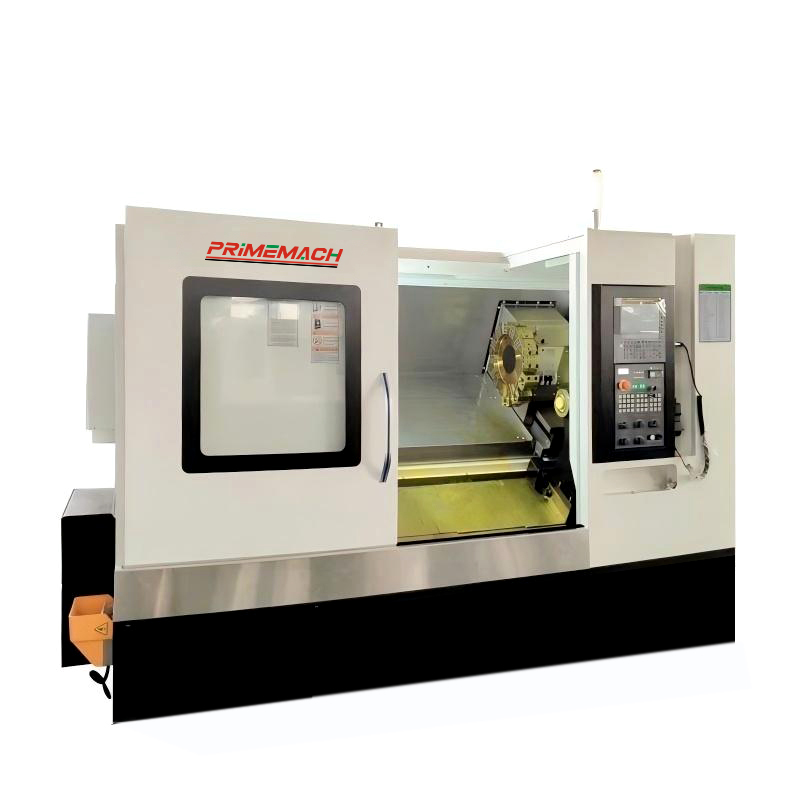
Processing these heavy alloys requires immense structural mass. The base casting must absorb heavy cutting forces. Meehanite cast iron provides excellent vibration dampening properties. Box guideways dampen vibrations far better than linear rails. They offer larger contact areas to distribute cutting loads. This massive foundation forms a reliable Heavy-Duty CNC Lathe. You need this mass to prevent chatter during heavy roughing passes.
Spindle torque matters far more than spindle speed. You need high-torque gearboxes operating at lower RPMs. High-speed direct-drive spindles lack low-end cutting power. They stall or degrade under heavy chip loads. Super-Duplex requires raw, uninterrupted torque to push the insert through the hardened material. A geared spindle provides the necessary mechanical advantage.
High-pressure coolant delivery systems are absolutely non-negotiable. You need a minimum of 70-100 bar (1000+ PSI) delivered directly through the tool. This pressure serves two critical functions. First, it breaks stringy, tough chips efficiently. Second, it prevents thermal shock at the cutting edge. Super-Duplex generates immense heat during the shearing process. High-pressure coolant blasts the heat away from the shear zone.
Live tooling capabilities offer significant manufacturing advantages. Multi-axis heavy-duty machines reduce the number of required setups. Moving a heavy part between different machines introduces runout errors. Live tooling allows milling and drilling in the same setup. It minimizes runout errors in complex valve bodies. This approach improves concentricity across critical sealing geometries.
Equipment Capability Comparison: Standard vs. Heavy-Duty
Feature | Standard Lathe | Heavy-Duty Requirement |
|---|---|---|
Guideway Architecture | Linear Rails (Roller/Ball) | Box/Slideways (Hand-scraped) |
Base Material | Standard Cast Iron / Fabricated | High-Mass Meehanite Cast Iron |
Spindle Drive | Direct Drive / Belt Driven | Multi-Speed Geared Headstock |
Coolant Pressure | 20-30 Bar (Flood) | 70-100+ Bar (Through-Tool) |
Insert selection dictates process stability. PVD (Physical Vapor Deposition) coated carbide inserts often outperform CVD (Chemical Vapor Deposition) variants. PVD coatings are thinner. They maintain sharper cutting edges. Sharp edges shear high-strength, sticky alloys cleanly. CVD coatings tend to blunt the micro-geometry. Blunted edges cause rubbing, which induces work hardening immediately. Edge prep geometries must handle immense mechanical stress.
When programming a CNC Lathe for High-Strength Parts, you face a narrow processing window. Speeds and feeds require absolute precision. You must maintain a constant chip load at all times. Dwelling or tool hesitation causes instant strain hardening. Programmers must ensure the tool remains constantly engaged. If the tool stops feeding while spinning, the part surface hardens instantly.
Chip evacuation strategies prevent catastrophic part damage. Super-Duplex creates long, continuous, stringy chips. These chips wrap around the chuck or tool holder. Chip recutting destroys carbide inserts rapidly. You must evaluate programmable chip breaking cycles. Toolpath optimization ensures steady engagement and proper chip curling.
Use dynamic turning toolpaths to manage heat generation.
Implement low-frequency oscillation cutting to break stubborn chips.
Avoid zero-feed situations during entry and exit moves.
Utilize round inserts for roughing to thin the chip dynamically.
Implementation risk remains high across new projects. Manufacturer-recommended tooling data often fails in actual production. Catalog feeds and speeds are derived under perfect laboratory conditions. They rarely apply to heavy, interrupted cuts on large forgings. You must rely on empirical testing. Adaptive toolpath generation guarantees better results. Operators must tweak parameters based on real-time spindle load monitoring.
Material verification acts as the first line of defense. Positive Material Identification (PMI) is crucial for compliance. You must perform PMI testing before and after machining operations. It verifies raw material authenticity. It ensures no material mix-ups occurred during transit. Counterfeit or mislabeled alloys lead to catastrophic subsea blowouts.
Industry standards compliance separates qualified vendors from general machine shops. The facility must adhere to NACE MR0175 / ISO 15156 guidelines. They must follow NORSOK M-650 specifications strictly. These standards dictate specific heat treatment and processing rules. Failing to meet these standards renders the part unusable for sour gas service.
Surface integrity validation moves beyond basic dimensional checks. Visual inspection falls significantly short of oil and gas requirements. You must measure residual surface stress. Heavy turning can induce subsurface micro-cracking. Improper lathe operations alter the material's microstructure. Advanced metrology techniques, like X-ray diffraction, verify surface integrity. A flawless visual finish might hide dangerous internal stresses.
Digital traceability provides the final layer of accountability. The industry requires strict, unbroken documentation. Heat lot tracking ensures every part traces back to the original steel mill. Material test reports (MTRs) validate the exact chemical composition. You must link First Article Inspection (FAI) reports directly to the specific CNC program version used. This creates a closed-loop quality system.
Required Documentation for O&G Machining
Document Type | Purpose | Phase Required |
|---|---|---|
MTR (Material Test Report) | Validates chemical makeup and mechanical properties. | Receiving / Pre-machining |
PMI Report | Verifies alloy grade matches the MTR physically. | Pre & Post-machining |
FAI (First Article Inspection) | Confirms dimensional compliance of the first setup. | Production Approval |
Certificate of Conformance (CoC) | Guarantees all NACE/NORSOK standards were met. | Final Shipping |
Vendor audit frameworks help expose capabilities quickly. Tour the facility carefully before awarding contracts. Check the condition of their coolant systems. Foul-smelling coolant indicates poor maintenance and bacterial growth. Examine the rigidity of their workholding setups. Custom heavy-duty chuck jaws are required for large forgings. Look for dedicated high-strength material zones. Segregating Super-Duplex prevents cross-contamination from carbon steel dust.
Assess operator expertise directly during the audit. General stainless steel experience is insufficient. Turning 304 or 316L does not prepare a machinist for UNS S32750. Programmers need specific duplex and super-duplex background. Ask them how they manage tool deflection. Ask how they program entry feeds to prevent insert chipping.
Watch out for immediate red flags during the quoting phase. Avoid vendors quoting standard 316L machining times for Super-Duplex. These quotes prove they do not understand the material. Lack of in-house metrology is dangerous. Large, heavy parts require specialized CMM equipment. If they cannot measure a two-ton valve body in-house, they cannot guarantee tolerances.
Define clear next-step actions for vendor onboarding. Follow these actionable steps to qualify a new partner:
Request a detailed capability study on similar high-nickel alloys.
Commission a paid prototype run on a non-critical component.
Review their tool life management protocols closely.
Verify their CMM calibration records and metrology footprint.
Machining Super-Duplex stainless steel requires strict risk management. Process control determines success or failure in the oil and gas sector. Standard machine tools simply cannot handle the extreme physical demands. Heavy-duty equipment paired with rigorous tooling protocols ensures reliability. High-pressure coolant and rigid box-way architectures form the foundation of success.
You must prioritize vendors who understand metallurgical integrity. Evaluate their compliance with NACE and NORSOK standards thoroughly. By demanding full traceability, you protect critical subsea infrastructure. Submit your technical drawings for a comprehensive manufacturability review today. Schedule a technical consultation to safely transition your high-strength alloy production to a specialized facility.
A: Typically 40-60% slower. This reduction is necessary due to lower surface speeds. Operators must maintain strict, continuous chip loads to prevent work hardening. Pushing speeds too high burns out inserts rapidly and damages the workpiece.
A: No. High-pressure, through-tool coolant is mandatory. It breaks the stringy chips effectively. It also manages the extreme heat generated at the shear zone. Standard flood coolant boils away before reaching the cutting edge.
A: Dimensional instability caused by severe tool deflection. Surface finish degradation is also common. This results from work hardening or built-up edge (BUE) forming on the carbide insert during the cut.
A: Both. Premium tooling will catastrophically fail on a machine lacking structural rigidity. The machine base, spindle torque, and tool must work as a unified, vibration-free system to process these alloys successfully.


