

Views: 0 Author: Site Editor Publish Time: 2026-07-31 Origin: Site


Aerospace shaft production involves incredibly high stakes across the entire manufacturing sector. Components like turbine and rotor shafts operate under extreme stress and intense cyclic loading. In this demanding environment, catastrophic component failure is never an acceptable option. Manufacturers face a significant operational challenge when approaching these projects. They must carefully balance the extreme material properties of titanium, typically the Ti-6Al-4V alloy, alongside the stringent tolerance requirements of modern aerospace applications. Generic machining processes routinely fail when applied to these specialized components. This article provides procurement and engineering teams with an evidence-based evaluation framework. You will learn exactly how to assess manufacturing partners and evaluate equipment capabilities for precision titanium turning. We will thoroughly cover thermal management risks, rigid process controls, and strict compliance standards. This comprehensive guide will help you make informed, confident sourcing decisions for your critical aerospace shaft projects.
Titanium’s low thermal conductivity and work-hardening tendencies require specific machine architectures, not just standard turning centers.
Rigidity and chip management are paramount; evaluating a vendor’s use of a Slant Bed CNC Lathe is a strong indicator of capability for aerospace-grade titanium.
Compliance (AS9100D) and traceable quality control (CMM, FAI) are non-negotiable baselines, but true vendor expertise is proven through optimized tooling strategies and predictable lead times.
Cost-per-part evaluations must transparently account for rapid tool wear and high scrap-value risks inherent to titanium.
Applying generic machining processes to titanium aerospace shafts almost always ends in failure. Standard setups routinely cause dimensional inaccuracies, high scrap rates, and severe budget overruns. You cannot treat titanium billets like standard steel or aluminum materials. Aerospace engineers specify titanium for its incredible strength-to-weight ratio and exceptional corrosion resistance. However, these exact same physical properties make it notoriously difficult to machine accurately.
Thermal management presents the most significant operational risk. Titanium features an exceptionally low thermal conductivity rate. When you cut most common metals, heat dissipates naturally into the metal chip and carries away from the part. Titanium reacts completely differently during cutting. Heat concentrates directly at the cutting edge of the tool. This intense, localized heat quickly destroys cutting inserts. It also causes rapid thermal expansion in the workpiece itself. This thermal expansion leads directly to part distortion and ruined dimensional tolerances once the part cools.
Furthermore, aerospace shafts often feature high length-to-diameter (L/D) ratios. Turning long, slender parts introduces significant deflection risks into the process. Titanium also has a relatively low modulus of elasticity. This means it tends to push away from the cutting tool and spring back after the pass. Deflection causes severe chatter during the cutting process. Chatter ruins the required surface finish and destroys concentricity. Both metrics remain absolutely critical for rotating aerospace components. You must control cutting forces carefully to prevent the slender shaft from bending.
Finally, understand that not all titanium is equal. Commercially pure titanium machines relatively easily in most shops. However, aerospace applications rely heavily on alloyed grades like Grade 5 (Ti-6Al-4V). These specific alloys contain aluminum and vanadium additives. They possess much lower machinability indexes compared to pure titanium. You need highly specialized machining strategies to cut them effectively without inducing dangerous residual stresses into the final part.
To achieve aerospace success criteria, vendors must utilize highly specific hardware configurations. You simply cannot meet sub-micron tolerances on lightweight, generic turning equipment. Evaluating a vendor's machinery requires understanding several mandatory hardware prerequisites. This ensures they possess the actual capability to deliver on their promises.
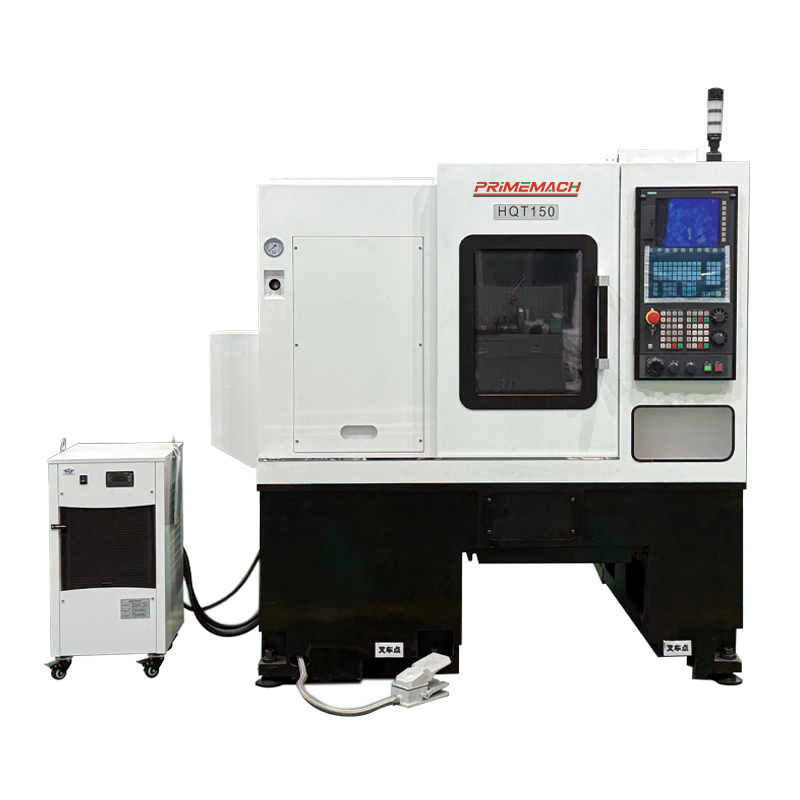
First, consider the overall machine architecture. Using a Precision CNC Lathe Machine built specifically for heavy cutting is entirely non-negotiable. Standard flatbed lathes simply lack the necessary cast-iron mass. We always look for machines equipped with heavy-duty box guideways rather than standard linear guides. Box ways provide vastly superior dampening characteristics. They absorb the massive, low-frequency vibrations generated during titanium turning operations.
Furthermore, evaluating a vendor’s use of a Slant Bed CNC Lathe reveals their true operational capability. Slant bed designs offer exceptional structural rigidity because the cutting forces direct straight down into the heaviest part of the casting. The angled bed design also provides gravity-assisted chip evacuation. Titanium chips are highly abrasive and notoriously prone to stringing. If a machine recuts its own abrasive chips, tool failure happens almost instantly. Efficient, natural chip flow away from the critical cutting zone remains mandatory.
Next, evaluate the coolant delivery systems on their equipment. Standard flood coolant is completely insufficient for machining Ti-6Al-4V. You need high-pressure, through-tool coolant systems operating at 1000 PSI or higher. This intense high pressure literally shatters the tough titanium chips into smaller, manageable pieces. It also forces coolant fluid directly into the extreme heat zone at the cutting edge. This action effectively breaks the thermal barrier and protects the carbide insert from premature failure.
Finally, complex aerospace shafts often require live tooling and full Y-axis integration. Multi-axis capabilities allow a machine shop to turn, mill, drill, and tap parts within one single setup. Reducing manual part handling maintains your critical datum points perfectly. It guarantees flawless concentricity across complex shaft features like milled splines, keyways, and cross-holes.
An impressive equipment list only tells half the story of a machine shop. You must rigorously assess how a manufacturing partner applies daily process control. True machining expertise reveals itself clearly through their operational choices on the shop floor. Assessing these dimensions helps separate capable partners from risky vendors.
A vendor's tooling strategy serves as a prime indicator of true competence. Titanium demands positive rake angles and exceptionally sharp cutting edges. Sharp tool edges shear the tough material cleanly rather than pushing it. This shearing action prevents dangerous smearing and galling on the finished shaft surface. Manufacturers typically debate using carbide versus ceramic inserts. For titanium shaft turning, specialized micro-grain carbide usually performs best. Furthermore, you should look for evidence of predictive tool replacement schedules. A vendor who runs cutting tools until they fail will ruin expensive titanium billets. They must replace inserts based strictly on time-in-cut metrics.
Handling high L/D ratios requires deep technical knowledge from the programming team. Long aerospace shafts naturally want to deflect under heavy tool pressure. Ask your vendor how they consistently maintain sub-micron tolerances on slender parts. Solid evidence of expertise includes utilizing fully programmable tailstocks. They should also deploy custom hydraulic steady rests and specialized collet systems. These workholding devices support the workpiece dynamically during the entire cutting pass.
Surface finish integrity matters immensely for aerospace applications. Aerospace turbine shafts undergo extreme cyclic loading during every flight. Improper finishing passes introduce invisible residual stress into the material. Residual stress severely compromises the fatigue life of the entire rotating component. Your vendor must deeply understand how to balance cutting speeds and feed rates. They must achieve the exact required Ra finish without microscopically damaging the shaft surface through heat or friction.
Process Element | Generic Machining Approach | Titanium Aerospace Machining Approach |
|---|---|---|
Coolant System | Standard flood coolant (low pressure, high volume) | High-pressure through-tool systems (1000+ PSI) |
Tooling Approach | Run-to-failure acceptable for standard metals | Strict predictive replacement schedules mandated |
Guideway Style | Linear guides (optimized for rapid travel speed) | Box guideways (optimized for heavy vibration dampening) |
Chip Management | Manual clearing or basic flatbed conveyors | Gravity-assisted slant bed flow away from tools |
Trust requires rigorous verification. When dealing with critical turbine or rotor shafts, vendor capabilities must align perfectly with established industry standards. A robust quality assurance framework protects your supply chain from catastrophic liabilities. It also ensures every part flying meets regulatory approval.
Certain manufacturing certifications are entirely non-negotiable. At an absolute minimum, your chosen manufacturing partner must hold AS9100 Rev D and ISO 9001 certifications. You should always require transparent, up-to-date certification documentation before signing any purchase orders. These standards prove they actively maintain an aerospace-grade quality management system. AS9100 Rev D specifically requires strict risk management and configuration control processes.
Robust inspection protocols form the sturdy backbone of this compliance framework.
First Article Inspection (FAI): Vendors must provide comprehensive FAI reports compliant with the AS9102 standard. This extensive documentation proves their specific process yields correct dimensions before full production starts.
In-Process Probing: Operators should routinely use spindle-mounted probes. This allows them to verify critical dimensions while the part remains securely in the chuck, preventing accumulating positioning errors.
Post-Process Verification: Final validation requires an advanced Coordinate Measuring Machine (CMM). This machine must be located inside a strictly temperature-controlled inspection laboratory.
Material traceability remains equally critical in this sector. You cannot accept unverified titanium in aerospace projects under any circumstances. Ensure the vendor practices incredibly strict lot control. They must maintain DFARS compliance if you operate within government or defense supply chains. They must provide a certifiable, unbroken chain-of-custody for every single titanium billet. This paperwork traces the material all the way back to the original mill melt.
Procurement teams need a highly realistic view of commercial factors. Titanium machining involves unique economic challenges not found in aluminum or steel production. You must fully understand these specific variables to evaluate incoming quotes accurately.
Scrap and raw material costs heavily dominate the overall pricing structure. Aerospace-grade titanium billets are incredibly expensive per pound. A vendor’s internal scrap rate directly influences your final unit economics. If they struggle to hold tight tolerances, they waste highly valuable material. High scrap rates will inevitably inflate your final purchase price. Unlike aluminum, titanium turnings hold very little scrap recycling value.
Tooling amortization represents another major cost driver. Machining Ti-6Al-4V consumes expensive cutting inserts rapidly. Vendors must logically factor this high rate of tool wear into their pricing structure. A transparent, honest partner will explain their specific tooling costs upfront during the quoting phase. Be extremely wary of bids appearing unusually low. They almost certainly underestimate the massive tooling consumption required for titanium turning.
Finally, you must constantly balance throughput versus precision. There is a direct inverse relationship between cutting speed and tool life when cutting titanium. Running machines faster destroys tools rapidly and ruins expensive parts. Evaluating vendors means looking closely at how they balance cycle times against process reliability. Predictable, slightly slower cycle times ensure consistent, on-time delivery. Rushed cycle times inevitably lead to broken tools, scrapped parts, and severely missed deadlines.
Selecting the right vendor requires precise, objective decision logic. Procurement and engineering teams must align their evaluation criteria closely. Use this concise, actionable framework to audit potential manufacturing partners effectively.
Step 1: The Capability Audit. Do not accept general manufacturing experience claims. Request highly specific case studies. Ask to see physical examples involving titanium aerospace shafts. Ensure these examples feature similar L/D ratios and comparable tight tolerance bands to your specific project.
Step 2: The Tooling and Process Interview. Get their lead engineering team on a technical call. Ask potential vendors to explain their specific speed and feed strategies openly. Have them detail their coolant setups specifically designed for Ti-6Al-4V. Hesitation or vague answers here usually reveal a lack of real-world experience.
Step 3: Prototyping and FAI. Never jump straight into full-volume production. Establish crystal clear success metrics for an initial prototype run. Focus specifically on concentricity results, surface finish metrics, and flawless material certification traceability.
Producing reliable aerospace shafts demands uncompromising excellence at every single stage. Successful CNC Lathe machining of titanium relies on far more than just buying the right equipment. It requires applying rigid process controls and executing intense thermal management daily. It also demands strict, unwavering compliance with complex aerospace quality frameworks.
Procurement and engineering teams must always look deeply beyond the initial quoted price. You need dedicated partners who prioritize machine rigidity, utilize predictive tooling schedules, and painstakingly verify every dimension. Take the necessary time to audit their machinery and interview their engineers thoroughly before committing your critical supply chain.
Are you ready to optimize your next critical shaft project? Submit your CAD files to our specialized engineering team today for a comprehensive manufacturability review. Contact us directly to discuss your specific aerospace shaft requirements and discover exactly how we can ensure perfect execution for your most demanding titanium components.
A: Realistic cutting speeds for Ti-6Al-4V typically range between 100 to 200 surface feet per minute (SFM). Slow cutting speeds combined with heavy, consistent feeds are standard practice. This specific approach prevents excessive heat buildup and successfully avoids work hardening. Pushing speeds higher rapidly degrades the carbide cutting edge and risks thermally damaging the workpiece.
A: A slant bed design provides significantly superior structural rigidity and excellent vibration dampening. This remains crucial for safely handling the high cutting forces generated by titanium. Additionally, the angled bed allows gravity to actively pull abrasive titanium chips away from the workpiece. This prevents dangerous chip recutting, which can instantly destroy expensive cutting tools.
A: Titanium work-hardens almost instantly if a cutting tool rubs against it instead of shearing properly. Interrupted cuts or dwelling in one spot hardens the material surface severely. This hardened layer aggressively destroys subsequent tooling passes. It heavily increases tooling consumption, raises scrap rates, and forces much longer production times, significantly driving up your final unit costs.
A: Precision turning centers can realistically achieve surface finishes around 16 to 32 micro-inches (Ra) on titanium components. Achieving this finish consistently requires razor-sharp carbide inserts and high-pressure coolant delivery. For critical aerospace shafts requiring ultra-fine finishes below 16 Ra, secondary operations like precision cylindrical grinding are often required to meet specifications safely and reliably.


