

Views: 0 Author: Site Editor Publish Time: 2026-08-17 Origin: Site


Burrs on surgical instruments like scalpels, forceps, and trocars represent a critical failure point in modern medical manufacturing. They directly risk severe tissue damage, dangerous post-operative infections, and catastrophic FDA product recalls. Relying on manual, post-process deburring introduces unacceptable human error into these highly regulated workflows. Manual abrasion methods consistently drive up per-part manufacturing costs while severely compromising microscopic dimensional repeatability across large production batches. You must strategically move burr control upstream by optimizing the CNC Lathe process directly to ensure true reliability. This comprehensive guide provides engineering and procurement teams with an objective, data-driven framework. We will thoroughly evaluate in-process burr mitigation techniques, compare automated deburring technologies, and outline strict industry standards. You will learn exactly how to vet and shortlist highly qualified medical machining partners for your next complex surgical device launch.
Effective burr control begins at the machine level; preventing rollover and breakout burrs during turning is significantly more cost-effective than removing them later.
Selecting the right equipment—such as a high-rigidity Precision CNC Lathe Machine or a high-speed CNC Gang Tool Lathe—is foundational to minimizing tool deflection and vibration.
Material selection (e.g., Titanium Gr. 5 vs. 17-4 PH Stainless) dictates the required tool geometry and coolant strategy to manage chip breaking and heat.
Vetting a machining partner requires looking beyond basic capabilities to audit their IQ/OQ/PQ validation frameworks and compliance with ISO 13485 standards.
Surgical instrument manufacturing leaves absolutely no room for edge defects. When you evaluate the production of critical medical devices, the business case for controlling burrs inside the machine becomes undeniable. Defect prevention always outperforms defect correction.
Medical device manufacturers operate under strict regulatory frameworks. Under FDA 21 CFR Part 820, traceability and process control form the backbone of compliance. A failure traced back to a microscopic burr can trigger an immediate, devastating product recall. When a scalpel blade or biopsy punch leaves a microscopic fragment behind in a patient, the liability risks multiply exponentially.
Furthermore, microscopic burrs severely impact sterilization efficacy. Even microscopic metal flakes create tiny crevices on the instrument surface. These crevices harbor bioburden, shielding dangerous pathogens from autoclave steam or chemical sterilants. Eliminating these defects at the source protects both the patient and your company's regulatory standing.
Many legacy facilities still rely heavily on manual deburring under microscopes. This approach introduces massive variability. Human operators, no matter how skilled, apply inconsistent pressure when using abrasive wheels or hand files. This inconsistency leads directly to compromised micro-tolerances.
When you rely on manual abrasion, you accept high scrap rates. Labor costs soar because highly paid technicians spend hours painstakingly scraping parts. Additionally, manual intervention severely disrupts cycle times. Scalable production becomes impossible when every batch faces a bottleneck at the deburring station. By eliminating manual steps, you stabilize output predictability.
How do we define success in upstream burr mitigation? The goal requires achieving a highly repeatable surface finish (Ra) and a clean edge break straight off the machine. We consider the process optimized when it requires zero manual intervention. Achieving this allows seamless integration into automated secondary processes, ensuring identical part geometry from the first piece to the thousandth.
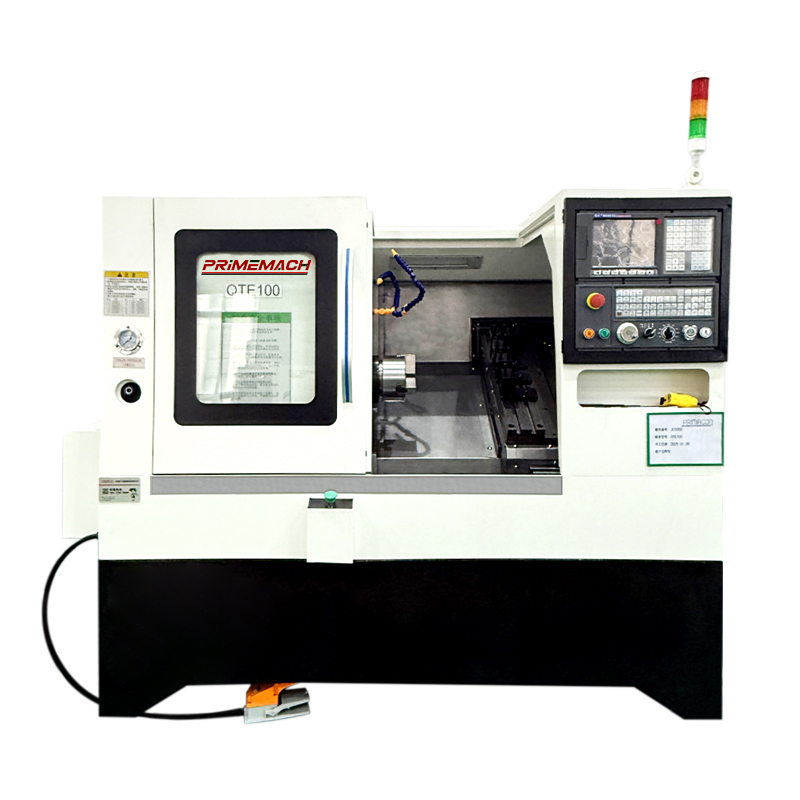
You cannot program your way out of a fundamentally unstable machine. Upstream burr control requires specific mechanical architectures capable of handling tough medical alloys without yielding to vibration.
When cutting medical-grade alloys like 17-4 PH stainless steel, structural rigidity dictates success. A purpose-built Precision CNC Lathe Machine utilizes heavy cast-iron bases and specialized guideways. These features actively dampen vibration during heavy cutting passes. Without this dampening, the tool chatters against the workpiece, creating microscopic marks and work-hardening burrs.
Spindle runout also plays a critical role. If a spindle deviates even a few microns during rotation, tool pressure fluctuates wildly. Inconsistent pressure tears the material instead of cleanly shearing it. High-end machines maintain near-zero spindle runout, guaranteeing smooth, burr-free cuts.
Micro-surgical parts, such as minimally invasive graspers or trocars, demand unique equipment. For sub-millimeter diameters, a traditional turret configuration often falls short. Instead, engineers utilize a CNC Gang Tool Lathe to achieve superior results.
This architecture mounts tools on a linear slide, completely eliminating turret indexing time. Fast tool transitions reduce dwell marks on the part. Because gang tooling sits much closer to the spindle, it minimizes tool deflection. Continuous, uninterrupted chip evacuation prevents chips from wrapping around tiny components and scarring the surface.
Gummy materials like 316L stainless steel present massive chip-breaking challenges. They tend to form long, stringy chips that drag across freshly machined edges, causing secondary burrs. You must utilize high-pressure coolant systems delivering 1,000+ PSI directly to the cutting zone.
This immense pressure acts like a liquid hammer. It forces the chip to bend and snap cleanly before it can entangle the tool. High-pressure coolant also drastically reduces thermal buildup, preventing thermal burrs and maintaining the sharpest possible cutting edge.
Once you secure the right equipment, the focus shifts to process engineering. Machinists must utilize clever programming and exact tool geometries to prevent material rollover.
Burr prevention relies entirely on how the insert interacts with the metal. We must select positive rake angles and ultra-sharp cutting edges. A sharp edge shears the material cleanly away. Conversely, a dull or negatively raked tool pushes the material, causing it to flow over the edge and form a thick rollover burr.
However, extreme sharpness creates a vulnerability. Extremely sharp tools wear out much faster, especially in tough alloys. Engineers must manage the trade-off between tool life and edge sharpness. We establish strict tool-change intervals based on part yield, replacing inserts long before they dull enough to generate burrs.
Smart programming can eliminate edge defects before the spindle stops. We frequently implement chamfering, radius programming, and thread relief grooves directly within the turning cycle.
For threaded surgical parts, standard threading often leaves a nasty root burr at the exit. Engineers employ "push-pull" threading techniques. By alternating the direction of the threading passes and utilizing spring passes (zero-cut passes), the tool cleanly severs the burr roots. The part leaves the chuck perfectly clean.
Different medical alloys behave differently at the exit point of a cut. Brittle alloys fracture, causing breakout burrs. Work-hardening stainless steels smear and tear. You must strictly adjust exit feeds to match the material profile. Slowing down the feed rate precisely at the edge exit prevents the tool from blowing out the back of the part.
Material Type | Primary Challenge | Burr Type Formed | Recommended Strategy |
|---|---|---|---|
Titanium Gr. 5 | Low thermal conductivity | Thermal/Smear burrs | Ultra-sharp positive rake, 1000+ PSI coolant. |
316L Stainless | Gummy, stringy chips | Rollover/Secondary burrs | High-pressure chip breaking, moderate feeds. |
17-4 PH Stainless | Work hardening | Hardened chatter burrs | Heavy depth of cut, strict tool-change limits. |
Cobalt Chrome | Extreme hardness/abrasion | Breakout burrs | Reduced exit feed rates, rigid clamping. |
We must acknowledge a hard truth: 100% burr-free turning remains a theoretical ideal for complex geometries. While optimization prevents massive defects, controlled secondary processes are often required for final regulatory compliance and validated edge-rounding.
Unlike manual tumbling, these automated processes offer incredible consistency. Facilities use high-density ceramic media paired with specialized chemical compounds. The centrifugal force uniformly removes micro-burrs across the entire batch.
Because the media acts isotropically (equally in all directions), it smooths the surface without altering critical dimensional tolerances. This method guarantees that a tight-tolerance scalpel handle remains perfectly in spec.
Certain surgical instruments feature complex internal geometries impossible to reach with physical media. Cannulas, internal threads, and biopsy punches require Electrochemical Machining (ECM). ECM acts as a reverse plating process, dissolving the burrs away using electrical current and electrolytes.
Risk consideration: Medical device manufacturers must enforce strict validation protocols when using ECM. You must guarantee no residual chemical contamination remains on the implant or instrument surface prior to packaging.
For extreme precision, manufacturers turn to laser deburring and TEM. These methods use focused energy or controlled gas combustion to instantly vaporize burrs in milliseconds.
Risk consideration: Vaporizing metal generates intense heat. You face a high potential for localized heat-affected zones (HAZ). HAZ can alter the mechanical properties of the alloy, making a surgical blade brittle. Extensive metallurgical testing must validate these thermal processes.
Technology | Best Application | Key Benefit | Primary Risk / Limitation |
|---|---|---|---|
Isotropic Superfinishing | External profiles, handles | Maintains micro-tolerances | Cannot reach deep internal holes. |
Electrochemical (ECM) | Cannulas, internal features | Burr removal without mechanical force | Risk of chemical residue. |
Thermal Energy (TEM) | Complex intersecting cross-holes | Instantaneous multi-part processing | Creates Heat-Affected Zones (HAZ). |
Procuring surgical instrument parts demands more than just finding a shop with open capacity. You must rigorously audit potential partners to ensure they possess true medical manufacturing expertise.
During your initial audit, ask one crucial question: Do they design processes for burr prevention, or do they simply rely on tumbling rooms to fix upstream errors? A qualified partner will show you toolpath simulations designed specifically to minimize edge rollover. They treat deburring as a controlled finishing step, not a salvage operation.
You cannot compromise on quality systems. Verify their ISO 13485 certification immediately. Look deeply into their First Article Inspection (FAI) capabilities. Do they use automated optical inspection (AOI) to detect sub-micron burrs? If they only rely on visual inspection via standard microscopes, they cannot guarantee zero-defect production at scale.
In medical manufacturing, you must validate the machine, the process, and the ongoing output. Ask how the supplier guarantees that tool wear won't introduce out-of-spec burrs halfway through a 10,000-part production run. They should present detailed IQ/OQ/PQ (Installation, Operational, and Performance Qualification) documentation proving their process remains stable over time.
Watch closely for these critical warning signs during your supplier audits:
Lack of documented tool-life management systems: If machinists change tools "when they look dull," the process is fundamentally out of control.
Over-reliance on manual deburring: Seeing dozens of workers hunched over microscopes with hand files for high-volume orders indicates a broken upstream machining process.
Poor environmental controls: Lack of temperature stabilization on the shop floor causes dimensional shifting and inconsistent cutting dynamics.
Incomplete traceability: Inability to link a specific batch of parts to the exact tool and raw material lot used.
Eliminating burrs on surgical instruments requires a highly holistic approach. It starts directly with strategic machine selection, leveraging precision and gang tool architectures. It continues through exact programming and stringent tool-life management. Finally, it ends with validated, automated surface finishing technologies that remove human error entirely.
Next steps: Procurement and engineering teams must proactively audit potential partners. Do not judge a supplier merely on their quoted part cost. You must evaluate their documented process controls, their rigorous tool-life management, and their data-driven scrap-reduction methodologies.
Actionable Prompt: Request an engineering review of your current surgical part prints today. Work with your manufacturing engineers to identify subtle geometry optimizations—like altering edge chamfers or adjusting thread reliefs—that will naturally reduce burr formation during the turning cycle.
A: ISO 13485 dictates strict quality management and process control rather than specifying exact burr sizes. Specific dimensional tolerances are always defined by the OEM print. However, medical industry standards typically demand strict zero-burr compliance, requiring parts to appear completely burr-free when inspected visually at 10x to 20x magnification.
A: A gang tool configuration mounts cutting tools on a rigid linear slide, eliminating the heavy mechanical indexing of a turret. This setup drastically reduces vibration and allows for rapid, seamless tool transitions. Less vibration and continuous engagement lead directly to cleaner cuts and significantly fewer burrs on micro-components.
A: No. While high-pressure coolant (1,000+ PSI) significantly reduces chip-recutting and prevents thermal burrs by cleanly breaking chips, it cannot entirely eliminate micro-burrs on complex geometries. Secondary automated deburring is often still required to achieve the validated, perfectly rounded edges demanded by medical implant standards.
A: Titanium has exceptionally low thermal conductivity, meaning heat stays trapped at the cutting edge. It also has a strong tendency to gall and smear. This requires ultra-sharp positive-rake tooling and aggressive high-pressure coolant strategies. In contrast, 17-4 PH stainless steel presents work-hardening challenges, demanding rigid setups and heavier cuts to prevent chatter burrs.


