

Views: 0 Author: Site Editor Publish Time: 2026-10-19 Origin: Site


Choosing between a slant bed and a flat bed CNC lathe represents a massive capital expenditure decision. Your choice directly impacts shop floor space, cycle times, and overall equipment effectiveness. Flat beds have long dominated traditional machining layouts. They offer a familiar, horizontal setup for conventional turning. However, modern production environments demand higher speeds and better chip management. Today, slant bed designs have largely become the industry standard for advanced manufacturing.
Selecting the right machine configuration requires careful evaluation. You must weigh workpiece size against production volume expectations. Budget constraints also play a major role in this choice. Finally, long-term automation goals will dictate which structural design yields the best return. By matching machine geometry to your exact operational needs, you ensure maximum productivity. This article explores the mechanical differences, application advantages, and risk factors of both machine styles.
Slant bed CNC lathes offer superior rigidity, thermal stability, and automated chip evacuation, making them ideal for continuous, high-speed production.
Flat bed lathes remain cost-effective powerhouses for heavy-duty, large-diameter, or extra-long turning applications.
The 30° to 60° incline of a slant bed maximizes floor space and improves operator ergonomics for tool changes.
For high-volume industries requiring tight tolerances (like aerospace or automotive), the higher upfront cost of a slant bed is quickly offset by faster cycle times and reduced maintenance downtime.
Understanding lathe architecture begins by examining the core casting geometry. Engineers design these machines to handle specific mechanical stresses. The foundation dictates how the machine performs under heavy loads.
The horizontal rail configuration sits exactly parallel to the shop floor. This traditional setup pushes cutting forces directly downward into the machine base. It relies heavily on sheer physical mass to maintain stability. Flat beds often utilize wide box ways to distribute heavy loads. This layout provides massive swing capacities for bulky parts.
A true slant bed features a solid cast iron saddle. Manufacturers angle this casting at 30°, 45°, or 60°. Do not confuse this genuine structure with a simple wedge design. Wedge designs merely bolt an angled plate onto a standard flat bed base. The true slant casting offers far better structural integrity. It behaves as a single, rigid monolithic unit.
The angled bed fundamentally alters the machine center of gravity. It redistributes cutting forces across a wider cross-section. Vector forces from the cutting tool push directly into the massive bedway. This unique geometry minimizes harmful vibration naturally. It virtually eliminates tool chatter during aggressive heavy cuts. A stable platform ensures better surface finishes and longer tool life.
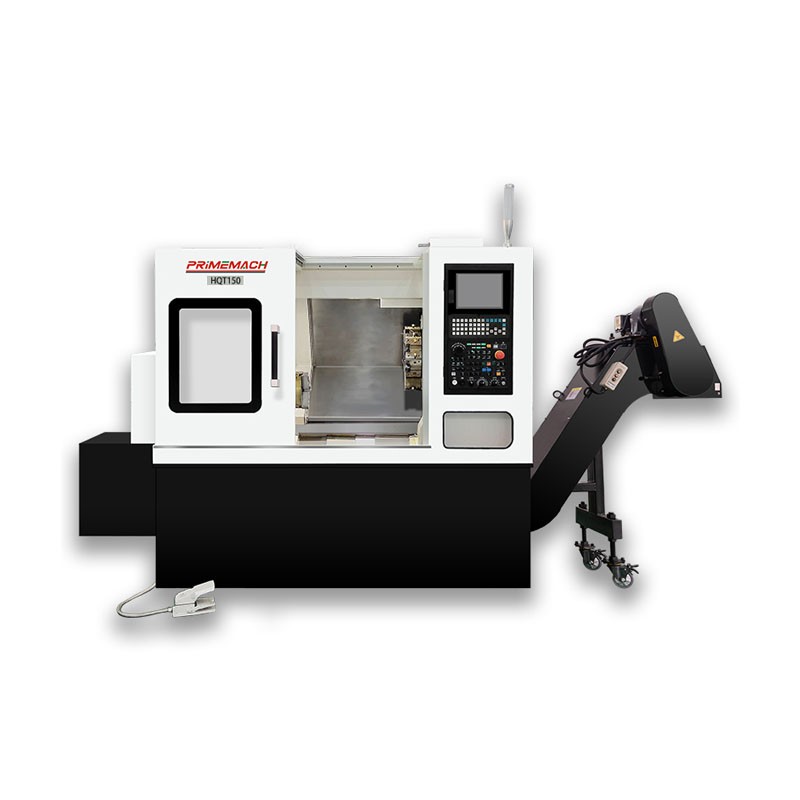
Modern production facilities gravitate toward inclined architectures for several compelling reasons. These machines solve many daily operational headaches automatically.
Gravity does the heavy lifting here. It naturally pulls hot chips and coolant away from the cutting zone. Debris drops directly into the conveyor below. This simple physical advantage prevents thermal distortion entirely. It also eliminates surface scratching on finished precision parts. Operators spend less time halting production to clear nested chips.
The closed-loop triangular structure of an inclined bed CNC lathe handles much higher spindle speeds. It tackles tougher exotic materials effortlessly. You can push rapid feed rates without compromising tight dimensional tolerances. The robust structure resists twisting forces during heavy roughing operations. This rigidity translates directly into micron-level precision repeatability.
The spindle and turret sit much closer to the front door. This thoughtful placement dramatically eases setup tasks for operators. Tool changes become faster and physically easier. It also reduces the overall Z-axis footprint significantly. You save valuable real estate on a crowded shop floor. Better ergonomics reduce operator fatigue and minimize workplace injuries.
Multi-shift operations thrive on this automated platform. High-volume, lights-out manufacturing environments benefit immensely from its reliable performance. If you run hundreds of identical parts daily, this architecture delivers unmatched consistency. Contract manufacturers seeking maximum spindle uptime should consider this configuration mandatory.
Despite the dominance of inclined models, horizontal architectures still hold significant value. They solve specific engineering challenges perfectly.
The horizontal layout excels at supporting oversized, heavy parts. Oil and gas pipes, massive turbine shafts, and heavy cylinders require specialized handling. Flat beds accommodate overhead gantry cranes easily. Crane-loading becomes a straightforward, safe process. They also support massive steady rests securely. You can turn extraordinarily long shafts without mid-span deflection.
Flat beds feature a significantly lower financial barrier to entry. Job shops and prototyping labs often prefer them initially. When aggressive cycle time is not the primary performance metric, flat beds preserve precious capital. They deliver excellent versatility for mixed, low-volume production runs. Smaller businesses can expand their capabilities without taking on massive debt.
Manual machinists already know the flat-bed layout intimately. The familiar orientation reduces the learning curve drastically. Transitioning veteran staff to basic 2-axis CNC turning becomes much smoother. Operators adapt quickly to the intuitive horizontal setup. This familiarity reduces costly setup errors during the initial training phase.
Comparing these two architectures requires looking beyond surface-level features. You must evaluate how each design handles daily operational stresses.
Evaluation Criteria | Slant Bed Dynamics | Flat Bed Dynamics |
|---|---|---|
Thermal Dynamics | Chips fall away immediately. Cast iron expands evenly, maintaining precise axis alignment. | Chips pool on the bedway. Uneven heat transfer causes potential precision drift. |
Turret & Tooling | Easily accommodates heavy hydraulic turrets, live tooling, and complex Y-axis capabilities. | Typically limited to standard gang tooling or simple 4-way to 8-way electric turrets. |
Automation Readiness | Built specifically for seamless bar feeders, robotic loaders, and parts catcher integration. | Often requires expensive custom engineering and third-party retrofits to automate. |
Temperature control dictates dimensional accuracy. On a slant design, hot chips fall away rapidly. They never rest on the machine castings. This prevents localized heat transfer entirely. The iron expands uniformly, keeping axes perfectly aligned. Conversely, chips pool heavily on a flat bed. This traps extreme heat against the rails. You might notice precision drift during extended production runs.
Modern machining requires complex tool presentations. Slant architectures easily hold massive, multi-station hydraulic turrets. They excel at integrating live tooling and Y-axis off-center milling operations. They support heavier tools without sagging. Flat models normally stick to basic setups. They utilize standard gang tooling or simple tool posts. Complex milling operations remain difficult on horizontal layouts.
Unattended machining requires flawless automated workflows. Slant beds integrate seamlessly with pneumatic parts catchers and high-speed bar feeders. Robotic arms load and unload chucks without clearance issues. Everything flows naturally downward. Flat beds usually demand custom engineering to achieve similar automation. Clearing chips automatically from a flat surface remains a persistent engineering challenge.
Machine selection varies wildly based on your specific industry sector. Different materials and volumes dictate different mechanical requirements.
The slant bed CNC lathe stands as the undisputed default choice for repetitive manufacturing. It completely dominates the market as a primary CNC lathe for automotive components. Drivetrain parts, custom fasteners, and brake components demand extreme speed. Seconds per part matter immensely in automotive supply chains. The fast index times and rapid traverses keep costs low.
These specialized industries cut exotic, hard-to-machine alloys daily. Titanium, Inconel, and surgical stainless steel require absolute rigidity. Inclined structures handle these tough metals with minimal harmonic vibration. They hit tight micron-level tolerances consistently. The superior surface finish capabilities reduce the need for secondary polishing operations. Precision is entirely non-negotiable here.
Maintenance, repair, and overhaul (MRO) operations rely heavily on horizontal flat beds. Repairing large hydraulic cylinders demands massive swing clearances. Refurbishing heavy mining equipment requires immense weight capacities. For single-run, bespoke oversized parts, flat beds deliver unmatched utility. They handle awkward, unbalanced loads much better than inclined models.
Purchasing a new machine involves balancing initial costs against long-term operational savings. You must plan for facility impacts and maintenance schedules.
Slant designs typically carry a 20% to 40% initial price premium over flat alternatives. You must calculate ROI based on specific operational gains. Reduced tool wear saves substantial money over a year. Faster cycle times increase daily output predictably. Lower scrap rates boost overall job profitability. These combined factors often justify the premium within the first year.
Every machine design presents unique maintenance challenges. You must train your staff accordingly.
Slant bed risks: They utilize complex linear guideways. Their advanced hydraulic turrets require specialized preventative maintenance. Troubleshooting requires higher technical skill.
Flat bed risks: Operators must intervene manually to clear chips often. Trapped chips carry a very high risk of scoring the box ways. Lubrication systems require constant monitoring.
Buyers must check their shop floor load capacity carefully. Heavier, single-piece cast iron slant beds demand very sturdy foundations. You may need to pour thicker concrete pads. You also need dedicated space planned out for chip conveyor positioning. Flat beds usually require less specialized foundation work but take up more horizontal floor space.
Choosing your machine boils down to a clear operational decision matrix. Heavy, low-volume turning on a strict budget points directly to a flat bed. It handles massive parts efficiently and economically. Conversely, business scalability requires advanced architecture. Unattended machining, automated chip clearing, and extreme precision make a slant bed absolutely non-negotiable. They deliver the speed modern supply chains demand.
Buyers should audit their current part mix immediately. Document average dimensions, production volumes, and raw material types. Contact reputable machine tool distributors to request specific test cuts. Ask for detailed equipment effectiveness projections. You should test your toughest part on both platforms before finalizing your capital expenditure budget.
A: Yes, the initial purchase price is generally 20% to 40% higher. However, you must evaluate long-term operational costs. The superior chip evacuation, extended tool life, and faster cycle times often yield a faster return on investment for high-volume shops.
A: Yes, you can automate them. However, it is generally more clunky and far less efficient than automating an inclined machine. Flat beds often require custom-engineered robotic loaders. They heavily struggle with automated chip clearance during lights-out operations.
A: A true slant bed features a single, unified cast iron base poured at an angle. A slanted saddle simply bolts a wedge onto a traditional flat bed base. Bolt-on wedges introduce structural weak points. They do not offer the same supreme rigidity.
A: It depends entirely on your primary manufacturing goals. A 30° incline provides excellent rigidity for heavy cutting. A 45° bed offers a great balance of chip flow and operator ergonomics. A 60° bed maximizes chip evacuation and minimizes the overall floor footprint.


