

Views: 0 Author: Site Editor Publish Time: 2026-03-16 Origin: Site


In modern manufacturing, precision, speed, and cost-efficiency are no longer optional — they are the baseline. Whether you run a job shop, an aerospace supplier, or a mold-making facility, one machine consistently sits at the heart of production: the Vertical CNC Machining Center (VMC).
A vertical CNC machining center combines computer-controlled automation with multi-axis cutting capability, enabling manufacturers to produce complex, high-tolerance parts with minimal manual intervention. From aluminum brackets to titanium medical implants, VMCs handle an enormous range of materials and geometries — all within a single setup.
Yet despite their widespread adoption, many buyers — especially those entering the market for the first time — struggle with the same questions: How does a VMC actually work? What separates a good machine from a great one? And when does a vertical configuration make more sense than a horizontal one?
This guide answers all of that. You'll find a clear breakdown of what a vertical CNC machining center is, how it operates, what its key components do, where it excels, and exactly what to look for when choosing one for your shop.
A Vertical CNC Machining Center is a computer-numerically-controlled machine tool in which the main spindle is oriented vertically — perpendicular to the worktable. The cutting tool rotates on a vertical axis and moves downward into the workpiece, which is mounted on a flat, horizontal table beneath it.
Unlike a conventional manual mill, a VMC executes all cutting operations — milling, drilling, boring, tapping, and contouring — through pre-programmed instructions with no continuous manual input. The CNC controller interprets the G-code program and drives the machine's axes with precise, repeatable motion.
Most VMCs operate on three linear axes:
X-axis — left-to-right movement of the worktable
Y-axis — front-to-back movement of the worktable
Z-axis — up-and-down movement of the spindle
This 3-axis configuration handles the majority of flat, prismatic, and contoured part geometries. For more complex work, VMCs can be extended to 4-axis (with a rotary table) or 5-axis (with simultaneous tilting and rotating), enabling undercuts and compound angles in a single setup.
| Feature | Conventional Mill | Vertical CNC Machining Center |
|---|---|---|
| Control | Manual operator | CNC program (G-code) |
| Repeatability | Operator-dependent | ±0.001mm or better |
| Tool Changes | Manual | Automatic (ATC) |
| Complexity of Parts | Simple geometries | Complex 3D profiles |
| Production Speed | Slow | High |
The vertical spindle orientation gives VMCs a natural advantage for flat, plate-style, and top-surface-dominant parts. The workpiece lies flat on the table, making fixturing straightforward and setup times short. This geometry also allows operators to visually monitor the cutting zone with ease — a practical benefit in both prototyping and production environments.
As the most widely adopted CNC machine type globally, the vertical machining center is often the first CNC investment for growing shops — and frequently the most productive one.
Understanding how a VMC works helps you get more from the machine — better programming decisions, smarter fixturing, and faster troubleshooting. The process follows a clear, repeatable workflow from digital design to finished part.
Everything begins in CAD (Computer-Aided Design) software. The engineer creates a precise 3D model of the part, defining every dimension, surface, and tolerance. Common platforms include SolidWorks, Fusion 360, and CATIA.
The CAD file is imported into CAM (Computer-Aided Manufacturing) software, where the programmer selects cutting tools, defines machining strategies (roughing, semi-finishing, finishing), sets feed rates and spindle speeds, and generates a G-code program — the machine-readable instruction set.
The operator mounts the workpiece on the VMC's table using a vise, fixture plate, or custom clamp. The machine's work coordinate origin (WCS) is set using a tool presetter or edge finder. Cutting tools are loaded into the tool magazine.
With the program loaded, the CNC controller takes over. It precisely coordinates:
Spindle rotation — the cutting tool spins at the programmed RPM
Axis movement — the table and spindle move simultaneously along X, Y, and Z
Tool changes — the ATC swaps tools automatically between operations
Coolant delivery — flood or mist coolant is applied to manage heat and chip evacuation
The result: the raw material is progressively cut into the finished geometry with micron-level accuracy.
Once machining is complete, the part is measured — either on the machine using a touch probe, or off-machine using CMM (Coordinate Measuring Machine) equipment — to verify dimensional compliance before moving to the next process.
In a vertical machining center, the spindle drives a rotating end mill, drill, or other cutting tool downward into the workpiece surface. Material is removed layer by layer through a combination of:
Peripheral cutting — the side flutes of the tool remove material along a profile
Face cutting — the bottom of the tool removes material across a flat surface
Plunge cutting — the tool drives vertically into the material for pocket or hole features
This vertical cutting geometry is especially efficient for pockets, slots, contoured surfaces, and through-holes — features that are common in the vast majority of machined components.
A VMC is more than a spindle and a table. Each subsystem plays a specific role in delivering precision, speed, and reliability. Here's what matters and why.
The spindle is the performance core of the machine. It holds and rotates the cutting tool at programmed speeds, typically ranging from 6,000 to 24,000 RPM depending on the machine class.
Key spindle specifications include:
Speed (RPM) — higher speeds suit aluminum and non-ferrous materials; lower speeds with high torque suit steel and titanium
Power (kW/HP) — determines the depth of cut and material removal rate
Taper interface — BT30, BT40, BT50, or HSK determine tool-holding rigidity
Bearing preload — directly affects thermal stability and long-term accuracy
A worn or thermally unstable spindle is the single most common cause of dimensional drift in VMC production.
The worktable carries the workpiece and provides the X and Y axis travel. It is typically made from high-grade cast iron for rigidity and vibration damping.
Important table specs:
Table size (mm) — must accommodate your largest workpiece
T-slot configuration — for mounting vises, fixtures, and pallets
Load capacity (kg) — critical for heavy workpieces
The ATC is what separates a machining center from a simple CNC mill. It allows the machine to switch between tools automatically during a program — eliminating manual intervention between operations.
Magazine capacity — typically 16 to 60+ tools
Tool change time — leading machines achieve chip-to-chip times under 2 seconds
Type — umbrella-style (compact, lower cost) vs. arm-type (faster, suited for production)
A larger ATC capacity directly reduces the need for part re-fixturing, enabling more complete machining in a single setup.
The control system is the brain of the machine. It interprets G-code, manages axis motion, monitors system status, and provides the operator interface.
Dominant control platforms:
Fanuc — industry standard, widely supported globally
Siemens Sinumerik — favored in European manufacturing
Heidenhain — preferred for high-precision mold and die work
Mazatrol (Mazak) — conversational programming, operator-friendly
Control system choice affects programming flexibility, integration with CAM software, and long-term service availability.
These mechanical components translate the motor's rotary motion into precise linear axis movement.
Ball screws — high-efficiency, low-backlash lead screw assemblies driving each axis
Linear guideways — hardened steel rails with recirculating ball carriages providing smooth, accurate travel
Guideway preload class and ball screw pitch directly determine the machine's positioning accuracy and repeatability. High-end VMCs achieve positioning accuracy of ±0.005mm or better.
Coolant serves three functions: removing heat from the cutting zone, lubricating the tool-workpiece interface, and evacuating chips from the machined surface.
Common coolant delivery methods:
Flood coolant — high volume, general-purpose
Through-spindle coolant (TSC) — high-pressure coolant delivered directly through the tool; critical for deep-hole drilling and hard material cutting
Mist coolant — low-volume, suitable for aluminum and light cuts
The cast iron or Meehanite column and base provide the structural foundation. Mass and geometry determine vibration damping and long-term geometric stability — factors that directly affect surface finish and tool life.
Integrated chip conveyors and coolant filtration systems keep the machining environment clean and reduce downtime between parts. In high-volume production, chip management is not a minor detail — it is a throughput variable.
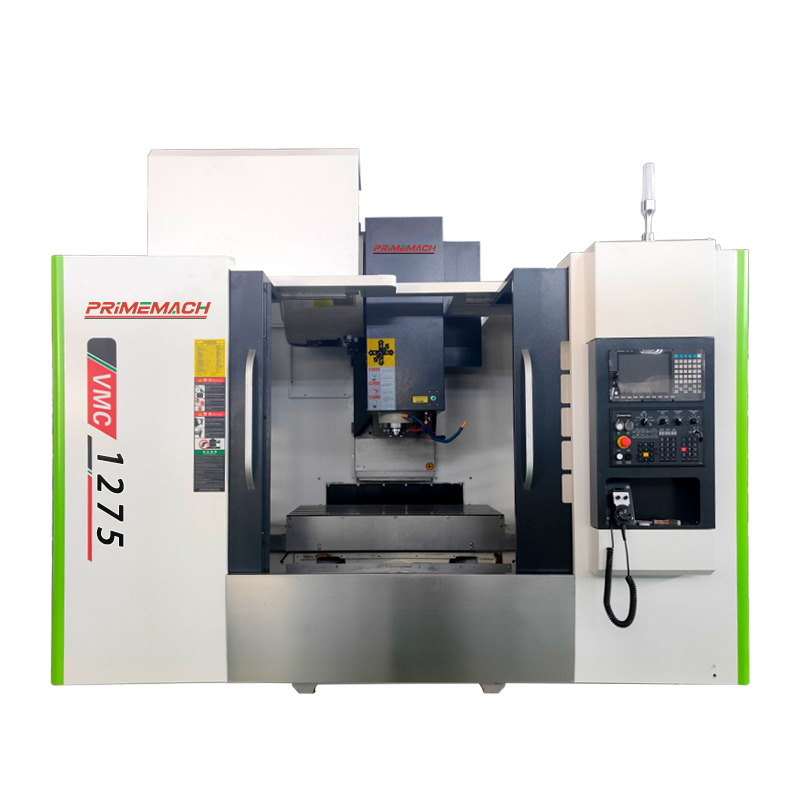
VMCs have become the dominant machine tool in modern manufacturing for good reason. Here are the seven advantages that make them the default choice for shops of all sizes.
A production-grade VMC holds tolerances of ±0.005mm routinely, with high-end models achieving tighter. Once a program is set and a fixture is qualified, every subsequent part comes out identical — eliminating the variability inherent in manual machining. This repeatability is essential for regulated industries like aerospace, medical, and defense.
With a capable ATC and the right programming, a VMC can perform milling, drilling, reaming, boring, tapping, and contouring without ever removing the part from the table. Fewer setups mean fewer opportunities for error — and faster cycle times.
A new mid-range VMC typically starts around $80,000–$150,000, while a comparable horizontal machining center (HMC) can cost $300,000 or more. For shops that don't require pallet-changing or four-face machining, the VMC delivers an outstanding return on investment at a fraction of the entry cost. Quality used VMCs are available from $30,000–$60,000, further lowering the barrier to entry.
VMCs occupy significantly less floor space than HMCs or multi-axis turning centers. A standard 40" × 20" travel VMC typically fits within a 4m × 3m floor area — a practical advantage in shops where space is at a premium.
The vertical configuration provides excellent operator visibility into the cutting zone. Combined with modern conversational CNC controls (such as Mazatrol or Fanuc Manual Guide), VMCs have a relatively low learning curve. Skilled machinists can typically be trained on a new VMC control within days, not weeks.
Workpieces can be clamped in a standard vise or bolted directly to the table with minimal fixturing. This makes VMCs ideal for low-volume prototype work and mixed-product job shops where changeover speed matters as much as cycle time.
Modern VMCs accept G-code output directly from all major CAM platforms — Mastercam, Fusion 360, Hypermill, and others. Post-processors are widely available, and simulation tools allow programmers to verify the toolpath and detect collisions before a single cut is made. This digital integration compresses the path from design to finished part.
Choosing between a VMC and an HMC is one of the most consequential equipment decisions a shop can make. Both are capable machines — but they excel in different scenarios.
| Criteria | Vertical Machining Center (VMC) | Horizontal Machining Center (HMC) |
|---|---|---|
| Spindle Orientation | Vertical (Z-axis down) | Horizontal (Z-axis lateral) |
| Purchase Price | $80K–$200K (new) | $250K–$600K+ (new) |
| Floor Space Required | Compact | Larger footprint |
| Chip Evacuation | Chips accumulate on part | Chips fall away by gravity |
| Ideal Part Geometry | Flat, plate-style, single-face | Cubic, multi-face, deep pockets |
| Fixturing Complexity | Simple (vise or plate) | Higher (pallet systems) |
| Best Batch Size | Prototype to medium runs | High-volume production |
| Spindle Utilization | Lower (manual refixtuing between faces) | Higher (pallet changer enables continuous cutting) |
| Learning Curve | Lower | Higher |
Your parts are flat, prismatic, or require machining on primarily one face
You run mixed-product, low-to-medium volume work
You need prototyping capability alongside production
Your budget is under $200,000 for a capable new machine
Your shop is space-constrained
Your parts require machining on four or more faces
You run high volumes of the same part with tight cycle time targets
Chip management is a production bottleneck (gravity chip fall in HMCs is a significant advantage for deep pocket work)
You are willing to invest in a pallet automation system for maximum spindle uptime
For the majority of job shops, contract manufacturers, and facilities introducing CNC machining for the first time, the VMC is the right starting point. It delivers high precision, operational flexibility, and fast ROI at a capital cost that makes business sense. The HMC earns its place as production volumes scale and part complexity demands multi-face machining in a single clamping.
Many advanced shops run both — VMCs for flexibility and setup efficiency, HMCs for dedicated high-volume lines.
The VMC's combination of precision, flexibility, and relatively low cost has made it a fixture across virtually every manufacturing sector. Below are the industries where VMCs deliver the most impact.
Aerospace components demand the highest dimensional tolerances and surface finish standards in manufacturing. VMCs — particularly 4- and 5-axis configurations — are used to machine structural brackets, fuel system components, avionics housings, and turbine blade fixtures from aluminum alloys, titanium, and Inconel. Traceability, process documentation, and repeatability are non-negotiable in this sector.
From engine blocks and cylinder head covers to transmission components and suspension brackets, automotive manufacturing relies on VMCs for both prototype development and low-to-medium volume production runs. VMCs are standard equipment in Tier 1 and Tier 2 supplier facilities where part changeovers are frequent and geometry varies by model year.
Orthopedic implants, surgical instruments, and diagnostic device housings require micron-level precision and biocompatible material machining (titanium, cobalt-chrome, PEEK). VMCs with high-speed spindles and fine-increment controls are the tool of choice for medical contract manufacturers operating under ISO 13485 and FDA quality frameworks.
Mold cavities, cores, and electrode blanks represent some of the most geometrically complex work in machining. High-speed VMCs with 5-axis capability are used to machine hardened steel (up to 62 HRC) and graphite electrodes, achieving mirror-finish surfaces directly off the machine and minimizing downstream EDM and polishing time.
Precision housings, heat sinks, connector bodies, and semiconductor equipment frames are typically machined from aluminum or copper on VMCs. The requirement for tight flatness tolerances, fine surface finishes, and complex pocket geometries makes the VMC the standard platform in this sector.
The broadest user base for VMCs is the general-purpose job shop — facilities that machine a wide variety of parts across materials, volumes, and industries. The VMC's operational flexibility, fast setup capability, and ease of reprogramming make it the ideal generalist machine for shops that cannot dedicate equipment to a single part family.
Axis count is one of the most important spec decisions when selecting a vertical machining center. More axes mean greater geometric capability — but also higher cost, more complex programming, and steeper operator training requirements.
A 3-axis VMC moves along the X, Y, and Z linear axes. It is the most widely used configuration globally and handles the majority of milled, drilled, and tapped parts efficiently.
Best for:
Flat and prismatic parts with features on one face
Prototyping and general job shop work
Shops entering CNC machining for the first time
Budget-conscious operations requiring high throughput
Limitation: To machine multiple faces, the operator must manually refixter the part — adding setup time and introducing potential for repositioning error.
A 4-axis VMC adds a rotary table (A-axis) to the standard 3-axis platform. The workpiece can rotate around the X-axis, enabling machining on multiple faces or around a cylindrical profile without re-clamping.
Best for:
Cylindrical or round parts requiring features on multiple radial positions
Cam profiles, impellers, and shaft-style components
Shops looking to expand capability without full 5-axis investment
Note: On most 4-axis VMCs, the rotary axis is indexed (positioned and locked), not simultaneous — meaning it positions the part but does not interpolate with other axes during cutting.
A 5-axis VMC adds two additional rotational axes (typically A and B, or A and C), allowing the cutting tool to approach the workpiece from virtually any angle. True simultaneous 5-axis interpolation means all five axes move together during a single cut.
Best for:
Complex sculptured surfaces (turbine blades, impellers, orthopedic implants)
Parts requiring undercuts or compound angles
High-value components where a single-setup approach eliminates re-fixturing error
Mold and die cavities with deep cores and complex draft angles
Investment consideration: 5-axis VMCs carry a significant price premium — typically $300,000 to $800,000+ for production-grade machines — and require advanced CAM programming skills. The ROI is justified when part complexity and tolerance requirements demand it.
| Your Situation | Recommended Configuration |
|---|---|
| General job shop, mixed parts | 3-Axis |
| Round or cylindrical parts, multi-face | 4-Axis |
| Complex aerospace / medical / mold work | 5-Axis |
| High-volume prismatic parts | 3-Axis with pallet system |
Buying a VMC is a long-term capital investment. The right machine will serve your shop for 10–20 years; the wrong one creates production bottlenecks from day one. Evaluate these eight criteria before committing.
Your machine's X/Y/Z travel must accommodate your largest workpiece — with clearance for the fixture. Common travel ranges:
Small VMC: 500 × 400 × 400mm — suitable for small parts, toolrooms
Mid-size VMC: 1,000 × 500 × 500mm — the most versatile class for job shops
Large VMC: 1,500mm+ X-travel — for large plates, molds, and structural components
Don't size the machine to your current parts only. Consider where your customer base may take you in the next five years.
Match spindle specs to your primary material:
Aluminum, plastics, composites: High speed (12,000–24,000 RPM), moderate torque
Steel, cast iron: Moderate speed (6,000–10,000 RPM), high torque (20kW+)
Titanium, Inconel: Low speed, very high torque, through-spindle coolant essential
A machine specified for steel that's regularly cutting aluminum — or vice versa — will consistently underperform.
Review your tightest part tolerances. If you regularly hold ±0.005mm or tighter, specify:
Full-closed loop feedback on all axes
Thermal compensation system
High-precision ball screws (Class 3 or better)
Spindle thermal growth compensation
For general machining at ±0.02mm, a standard mid-range VMC is more than sufficient.
As outlined in Section 8, match axis count to part complexity. Avoid over-specifying — a 5-axis machine running only 3-axis work is a poor use of capital. Equally, avoid under-specifying if your part mix is trending toward more complex geometry.
Count the number of unique tools your most complex part requires, then add 25–30% for tool-life management (duplicate tools for high-wear operations). A 24-tool magazine suffices for most job shop work; complex mold or aerospace programs may require 40–60 tool positions.
Prioritize controls that:
Your programmers and operators already know (or can learn quickly)
Have strong local service and support infrastructure
Integrate cleanly with your CAM post-processors
Offer the conversational programming features you need for setup efficiency
Fanuc is the safest choice globally for serviceability. Heidenhain is the benchmark for high-precision mold work. Siemens dominates in European supply chains.
Evaluate:
Casting quality — mass and material of the column and base
Guideway type — box ways (heavy cutting, higher friction) vs. linear guides (high speed, lower friction)
Spindle brand — in-house vs. third-party (NSK, GMN, Fischer)
Country of manufacture — Japanese and German machines set the standard; Taiwanese machines offer strong value; Chinese machines have improved significantly in the mid-range segment
Request inspection certificates and spindle run-out specifications before accepting any machine.
A VMC that sits idle waiting for a spare part or service engineer costs more than it saves. Before purchasing, confirm:
Local service engineer availability (response time)
Spare parts lead time for consumable items (spindle bearings, ATC components, ball screws)
Software update support for the CNC control
Training programs for operators and programmers
A CNC milling machine and a VMC perform similar cutting operations, but a machining center includes an Automatic Tool Changer (ATC) — enabling multi-tool operations within a single program without operator intervention. A basic CNC mill requires manual tool changes between operations. The ATC is the defining feature that makes a machining center suitable for production environments.
Pricing varies widely by size, axis count, and brand:
Entry-level / used VMC: $20,000–$60,000
New mid-range VMC (3-axis): $80,000–$180,000
New high-performance VMC (3-axis, premium brand): $180,000–$300,000
5-axis VMC: $300,000–$800,000+
Total cost of ownership should also factor in tooling, fixturing, coolant management, and maintenance contracts.
VMCs machine a broad range of materials, including:
Metals: Aluminum, steel, stainless steel, titanium, copper, brass, Inconel, cobalt-chrome
Plastics: ABS, PEEK, Delrin, nylon, polycarbonate
Composites: Carbon fiber reinforced polymers (CFRP), G10/FR4
Graphite: For EDM electrode production
Material capability depends on spindle power, rigidity, and coolant system specification.
Basic operation — loading parts, running proven programs, making offsets — can be taught to a motivated operator in 2–4 weeks. Full programming proficiency using CAM software typically requires 3–6 months of hands-on experience. Mastery of complex 5-axis programming is a multi-year skill development path.
Choose a horizontal machining center when:
Parts require machining on four or more faces in a single setup
You are running high volumes (1,000+ parts/month) of the same component
Chip evacuation from deep pockets is a recurring production issue
You can justify the higher capital investment ($300,000+) through spindle utilization gains
For most shops, the VMC remains the right platform until volume and complexity specifically justify the HMC investment.
The Vertical CNC Machining Center is, by every measure, the most versatile and accessible high-precision machine tool available to manufacturers today. It delivers the accuracy, automation, and multi-operation capability that modern part geometries demand — at a capital cost that makes business sense for shops at every scale.
Whether you are setting up your first CNC cell, expanding an existing job shop, or sourcing precision capacity for aerospace or medical contracts, the VMC belongs at the center of your evaluation. Understand your part requirements, match the machine specs to your tightest tolerances and largest workpieces, and choose a platform with the service infrastructure to keep it running.
The right VMC doesn't just machine parts — it defines what your shop is capable of delivering.


